"Noted photographer Linda Rutenberg invites you on a nocturnal journey as share stories and images of twenty public gardens throughout the United States and Canada. Her newly published book, The Garden at Night: Private Views of Public Edens features our very own San Francisco Botanical Garden along with 19 other spectacular gardens seldom seen at night. Refreshments, book signing and evening tours of the Garden."
Link.
10/29/2007

File under: San Francisco, freaks in
"Aline Xayasouk, dressed up as a piece of sushi, became San Francisco's first cardboard fighting champion."
Link.
Link.
"France's president abruptly ended a 60 Minutes interview aimed at introducing him to U.S. audiences, dubbing it 'stupid' and a 'big mistake' and refusing to answer questions about his wife."
Link.
Good for him! I wish American politicians would do similarly. It would be better for everyone [in most cases] if our personal lives returned to being more personal.
Link.
Good for him! I wish American politicians would do similarly. It would be better for everyone [in most cases] if our personal lives returned to being more personal.
Everybody I know in San Francisco right now
is very excited about the opening next year of the new California Academy of Sciences.
You would be too:
And I think this sounds very exciting:
And that's just the botanically-related stuff.
(In my fantasy world, major American cities would compete with each other to have the best science museum.)
Link to the current Cal Academy webpage.
You would be too:
The entire top of the museum, with the exception of the piazza's glass ceiling, consists of the biggest sustainable roof in the world. It is essentially a planted garden stretching to all four walls, supporting 1.7 million plants, including California poppies and strawberries.
Counting the tops of the two domes - Morrison Planetarium and the living rain forest - the roof sports a total of seven soil hills, mimicking the seven hills of San Francisco. This serendipitously also echoes the seven hills of Rome - capital of the home country of the man who designed the new museum, Italian architect Renzo Piano.
And I think this sounds very exciting:
Perhaps the most visually stunning feature of the new building will be the four-story-high glass dome that will house an exhibit of four rain forest habitats, all kept at a constant 82 degrees.
This dome will feature several palm and other trees soaring 70 feet high, and a winding ramp and an elevator will lead visitors to the four different habitats.
The first floor of the dome will imitate the rain forest of Borneo, with a live colony of bats living alongside snakes and flying geckos, frogs and lizards. The second floor will house Madagascar ants and chameleons, and the third floor will feature the birds and butterflies of Costa Rica, all flitting through the canopies of the dome's gigantic trees.
Finally, the basement will take visitors beneath a living mockup of a flooded Amazonian rain forest floor. To save visitors the trouble of swimming through heated muck, there is a long, acrylic tunnel that will allow them to stroll through and gaze directly into the bottom of the forest with its mangroves, soggy tree roots and freshwater fish.
And that's just the botanically-related stuff.
"The plans for every room, every glass-walled tank, and every exhibit of rain forest trees will bespeak the museum's basic mission: to tell the world how life evolved on planet Earth, how its diversity has spread across all the seas and continents, and how every visitor must come away newly committed to protect and sustain these infinitely varied life forms that are now threatened everywhere."
(In my fantasy world, major American cities would compete with each other to have the best science museum.)
Link to the current Cal Academy webpage.
"The Fires Next Time"
WSJ:
Yes.
As it is, the over-regulated insurance market and the promise of federal emergency money means we're effectively paying people to live in communities that destroy our wildlands.
I don't get it.
Until insurers are allowed to charge premiums high enough to cover actual risks, people will continue to build and reside in places they probably shouldn't, secure in the knowledge that when Mother Nature inevitably strikes, someone else will write a rescue check.
According to a recent study of 11 Western states by Headwaters Economics, just 14% of the wildland urban interface [WUI] is currently developed. But that number has been growing steadily, as have the costs of protecting the WUI. Since 1992, the Forest Service's fire expenditures have grown by 450%, and well over half of that has been spent protecting private property next to public land.
"The only behavioral change I can imagine is if fire-fighting costs were borne by local counties," says Ray Rasker of Headwaters. "Right now, if you're declared a disaster area, FEMA will bail you out, or BLM will bail you out," he says, referring to the Federal Emergency Management Agency and the Bureau of Land Management, two of the more than two dozen federal agencies that respond to emergencies.
California's last big fires occurred in 2003 and largely in the same areas burning today. Which is to say these fires are not only natural but somewhat predictable in location. And while the immediate priority is to suppress them while giving aid and comfort to the displaced, policy makers might also look to mitigate the potential damage the next time they occur. And that means holding homeowners, developers, states and local communities more accountable. Link.
Yes.
As it is, the over-regulated insurance market and the promise of federal emergency money means we're effectively paying people to live in communities that destroy our wildlands.
I don't get it.
10/28/2007
Seed germination progress report
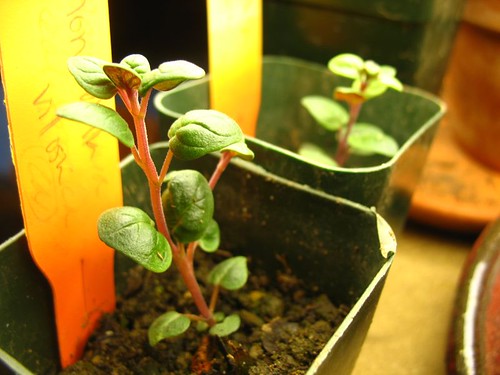
The Lotus formosissimus came up well.
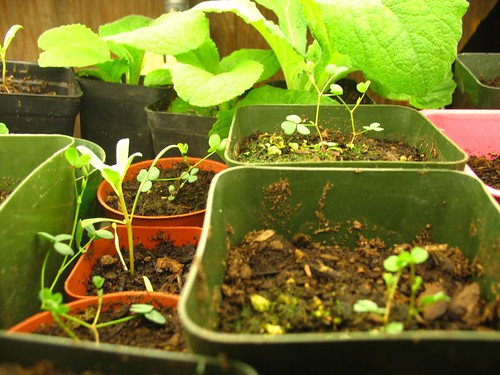
It's a little worrisome to me that the leaves look so much like a weedy oxalis. This is a west coast native from the Fabaceae. I'm not sure what to expect from it; I've never seen it before in real life, and it seems rather variable in pictures. Common names are Seaside Bird's-Foot Trefoil and Witch's Teeth.
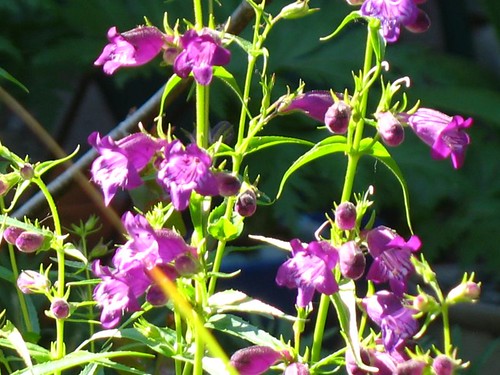
I bought the seeds several months ago, but I didn't sow them until Judith Larner sent this picture around, via her mailing list:
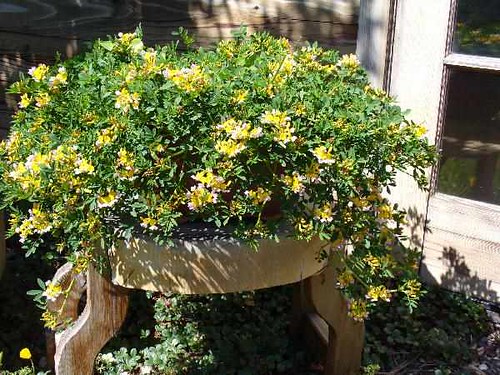
And, I was, like, yeah--sow those seeds ASAP. So I did.
Ms. Larner says:
Coast Melic, Melica californica. I tried these seeds before, but they didn't sprout. This time it worked. That happens a lot.
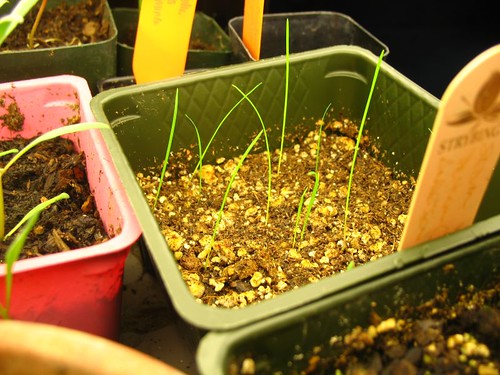
This, and Nassella pulchra (Purple Needlegrass) are slated to play a big role in the garden next year... The needlegrass is already planted out in the garden and doing fine.
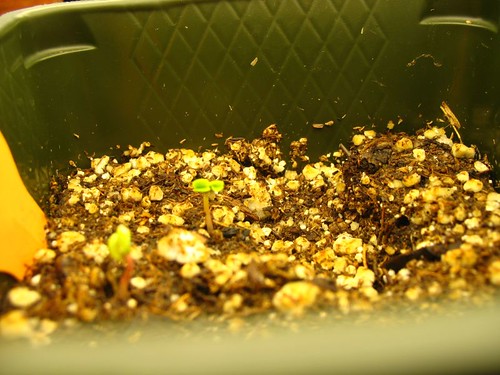
For some reason I had exactly two Coyote Mint (Monardella villosa) seeds in my fridge. Why? I don't know. Sowed 'em.
This is a small, short-lived native perennial that occurs in many situations. It's a good filler, bee-friendly, etc. I have three planted out, this will be five. The foliage has a nice, but not especially minty, fragrance.
Isomeris arborea, Bladderpod. Another plant I've never seen before.
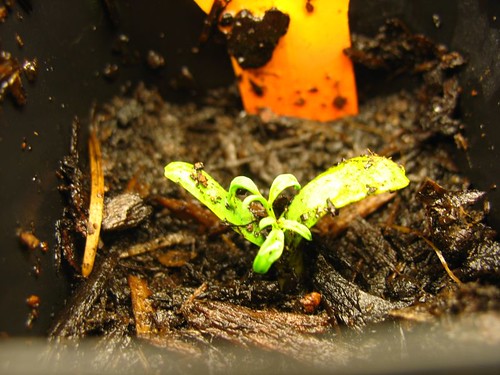
Apparently, it stinks. But it's supposed to be a good habitat plant and flowers constantly. I'm not sure what this plant's destiny in my garden is. Maybe I'll plant it at the pea patch. I think it grows in desert washes.
The Jacarandas came right up. Nooo idea what I'm going to do with these.
It's a little worrisome to me that the leaves look so much like a weedy oxalis. This is a west coast native from the Fabaceae. I'm not sure what to expect from it; I've never seen it before in real life, and it seems rather variable in pictures. Common names are Seaside Bird's-Foot Trefoil and Witch's Teeth.
I bought the seeds several months ago, but I didn't sow them until Judith Larner sent this picture around, via her mailing list:
And, I was, like, yeah--sow those seeds ASAP. So I did.
Ms. Larner says:
"Coast Lotus, (Lotus formosissimus), is a good example of one of the many beautiful 'small things,' the annual and perennial wildflowers, that pack a powerful punch ecologically and horticulturally, and are not commonly seen, even in native plant gardens. It is our goal to bring as many of these under-appreciated and frequently threatened species to your attention as we can. Lotus formosissimus is a good place to begin.
This species has many common names, including:coast lotus, bi-colored lotus, the beautiful lotus, (which it is), coast hosackia, and coast trefoil, but by any name, it's a fascinating, useful plant. Found on the coast in a number of situations, from Monterey County into Washington state, it likes damp swales and grassy headlands. Though it looks appealing next to California oatgrass in a prairie, we were amazed by the months of bloom it provided when coddled a bit in a container. It is thought to be the host plant of the almost extinct Lotis Blue Butterfly."
Coast Melic, Melica californica. I tried these seeds before, but they didn't sprout. This time it worked. That happens a lot.
This, and Nassella pulchra (Purple Needlegrass) are slated to play a big role in the garden next year... The needlegrass is already planted out in the garden and doing fine.
For some reason I had exactly two Coyote Mint (Monardella villosa) seeds in my fridge. Why? I don't know. Sowed 'em.
This is a small, short-lived native perennial that occurs in many situations. It's a good filler, bee-friendly, etc. I have three planted out, this will be five. The foliage has a nice, but not especially minty, fragrance.
Isomeris arborea, Bladderpod. Another plant I've never seen before.
Apparently, it stinks. But it's supposed to be a good habitat plant and flowers constantly. I'm not sure what this plant's destiny in my garden is. Maybe I'll plant it at the pea patch. I think it grows in desert washes.
The Jacarandas came right up. Nooo idea what I'm going to do with these.

10/27/2007
Fitzgerald Marine Reserve
I'm taking Plants and Animals of California at City College Thursday nights. The instructor was going to take the class here on a field trip, but something came up and she made this an optional, self-guided field trip.
So this isn't just a blog post. It's homework.
The Fitzgerald Marine Reserve is in the small town of in Moss Beach, a short drive south down Highway 1 from San Francisco.
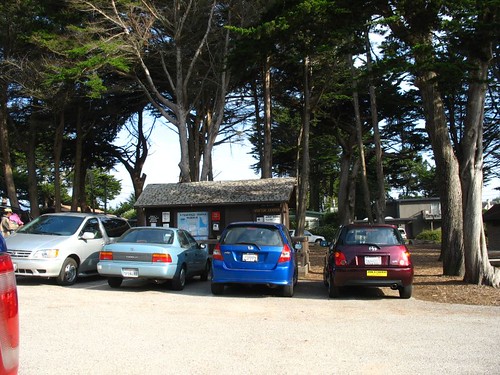

If I could sing, I just might join a chorus.
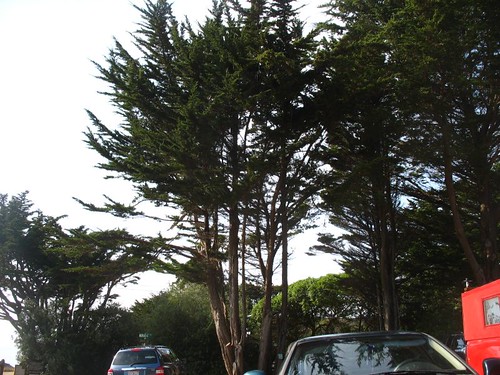
The trees are Cupressus macrocarpa, Monterey Cypress. Moss Beach is about 100 miles north of their native range, which is very limited. These trees have been planted widely in California (and other places), particularly in coastal environments where wind pruning sculpts them into uniquely beautiful specimens. But not here.
The book Introduction to California Plant Life says this:
The 2001 Sunset Western Garden Book says, "Away from cool coastal winds, C. macrocarpa is very subject to coryneum canker fungus, for which there is no cure. Look for foliage that first turns yellow then deep reddish brown, and falls off slowly. Destroy infected trees."
Like these?
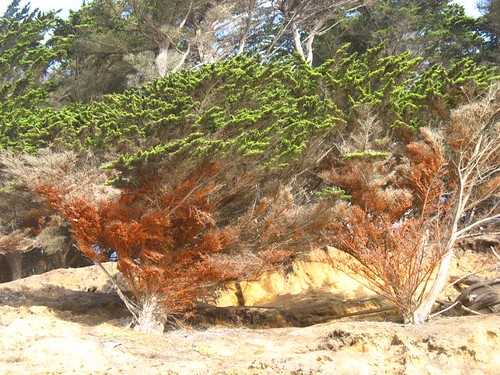
Maybe they have something else; these trees are growing in full exposure to "cool, coastal winds".
But we're not here to see trees.
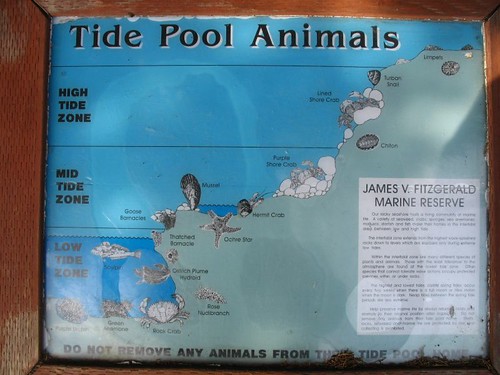
We've come to observe the tidepools, contemplate California's biodiversity, and appreciate the ecology of the plants and animals that live in this special habitat.
It's about 3:30 p.m., which happens to be somewhere between high and low tide this time of year.
(Link.)
The Reserve closes at 5, and we need to (want to) be home having coctails at 5, so this is the best we can do. (It's funny that Google, and the Blogger spellcheck, want you to spell cocktail with a k, but Wikipedia and quite a few other sources spell coctail with no k. Is this slow evolution into klessness unfolding right before our eyes? What are the selection pressures favoring or disfavoring k?)
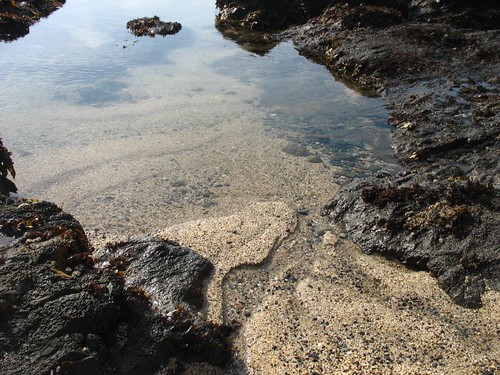
But I digress. The point is that during the time of our visit, water is receding back to the ocean.
Water is quite literally seeping out from the sandbank underneath my feet.
Professor Traut's handout for this field trip quotes some text by Bart Oxley and Bob Breen that says "Until its designation as a reserve in 1969, there was unlimited removal of wildlife from its tidepools, and at one time overflow crowds from San Francisco rushed to its shores to experience its touted reputation as a health spa."

Talking to the Volunteer Director at the San Francisco Botanical Garden about this class, I mentioned that we were going to come here on a field trip. He recalled visiting this beach as a child, before 1969, with his father and brother, and collecting crabs and such to take home. It seems so unthinkable now.

But there are a lot of people here today, and I feel certain some of them are collecting.
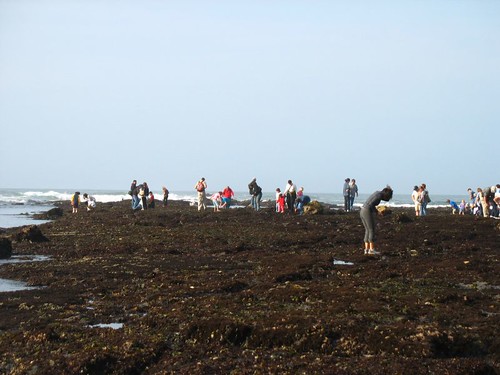
Don't you?
(As another assignment for the class, we're supposed to write an impact report about how human activities have adversely impacted California's ecology. I'm not going to do that assignment, but if I was going to, it might be interesting to write about how visitors to parks and nature reserves impact those places.)
But what's a reasonable, practicable solution to that problem? I don't know.
Anyhow, let's get on with it already.
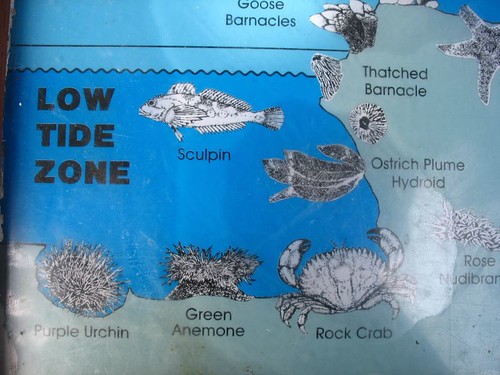
Ecologists describe this environment as the "rocky intertidal". They divide the rocky intertidal loosely into different zones...
Splash and High:
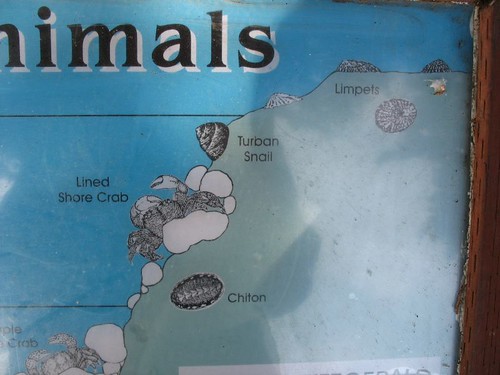
Middle:

Lower:
Of course, it's very clear where the rocky intertidal meets the sandy shore. I'm starting to think how interesting that is, that these two different environments abut each other so sharply. Such crisp borders are not often found when you think about it.
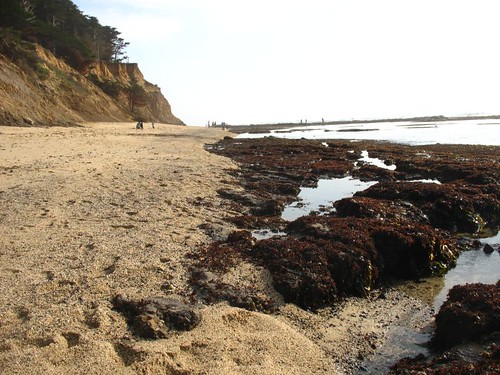
My class notes say, "Many small invertebrates live in between sand grains, lots of filter feeders (sand crabs)". I'm curious what it's like beneath the surface, where the sandy shore meets the rocky intertidal.
Judging by the animals that are visible in the pictures below, I would guess we're seeing the lower intertidal zone during this visit to the Reserve.
Time plays an interesting role in the rocky intertidal's biotic zonation. If you consider a mountain ecosystem, altitude and longitude distinguishes the alpine, subalpine, upper montane, and lower montane zones. Seasonal progressions bring change, but the zones remain more or less fixed geographically from day to day and year to year. In the rocky intertidal, zonal qualities change radically from hour to hour, every day, always.
Living in the rocky intertidal means being ready to cope with relatively extreme variations in water cover and dessication, exposure to predators, temperature, and wave action.
One of the things I've enjoyed thinking about in this class is the importance of space as a resource for living things. Living things take up space. Space is limited. How effectively an organism, or species, occupies and utilizes its space determines whether it gets to continue living there.
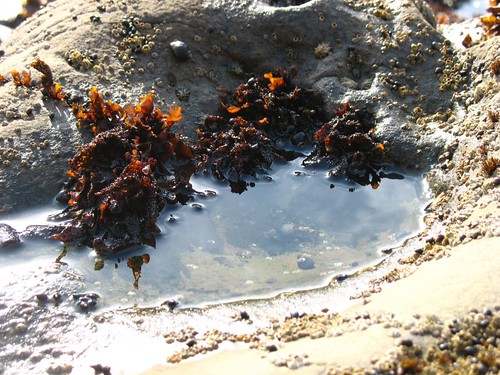
Competition must be fierce--especially in this environment, where the volume of living space contracts to a very small size indeed. This tiny pool will just get smaller in the next few hours as water evaporates.
This tight little crevice is filled with creatures vying for space.
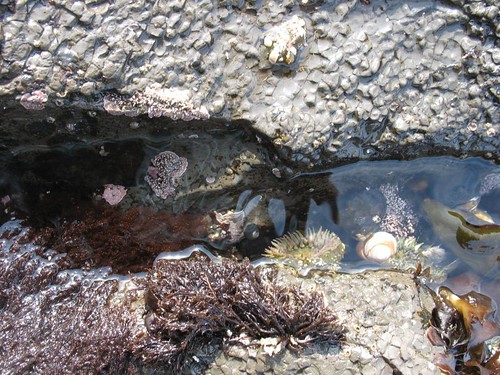
But then there are relatively big pools, nearly vacant.

Do you get more protection in a tight crevice than a big, open pool? Is that what explains the difference in population density? Or is this just random? If I observed this one pool every day during low tide for a year, how would it change?
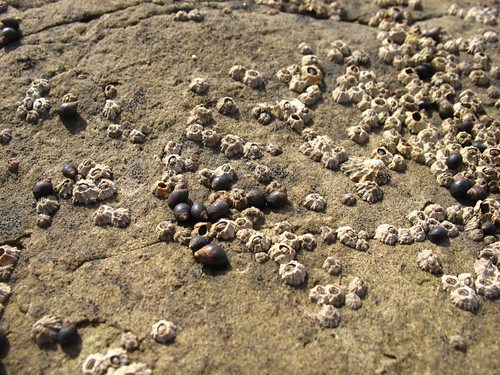
Two kinds of limpet vie for space here on top of this rock, in the upper intertidal zone. The gray little volcanoes are Chthalamus sp., commonly called Buckshot Barnacles. The little black snails are Littornia sp., commonly called Periwinkles.
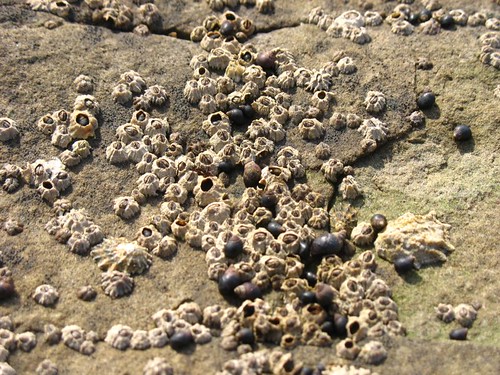
Chthalamus use a feather-like hind appendage to feed when the tide is in, and close up when the tide is out. They seal in water and resist dessication longer than the barnacles that grow lower down.
It seems like Chthalamus is winning the battle for space on this rock, but who can say. The flattened cone shape of barnacle shells helps to disperse the energy of crashing waves.
Red algae (Phaeophyta) typically grow deeper in the water than green algae where it effectively absorbs deeply penetrating (short wavelength) light at the blue end of the visible spectrum.
This kind looks strongly attached to the rock to better resist wave action. Note that its growth does not extend into the perpetually wet lower areas.
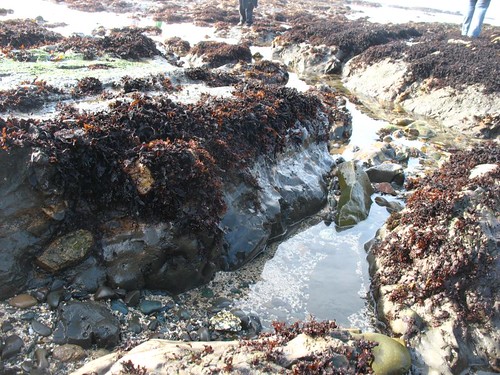
It's limited to the surface which dries out between high tides. The coarse, leathery texture resists dessication.
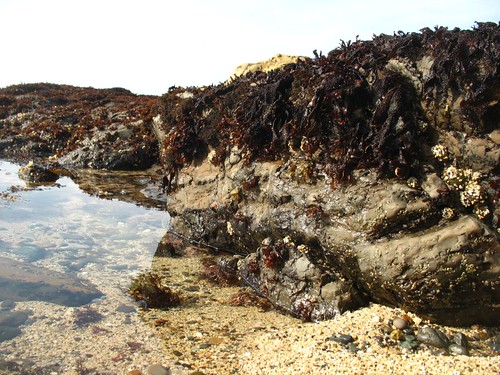
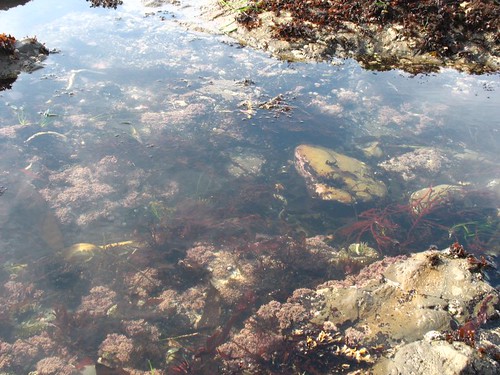
Other kinds of algae can occupy the submerged bottoms. The brown algae in this picture is long and filamentous. I would guess it has a higher surface area overall than the flattened kind in the drier zone above.
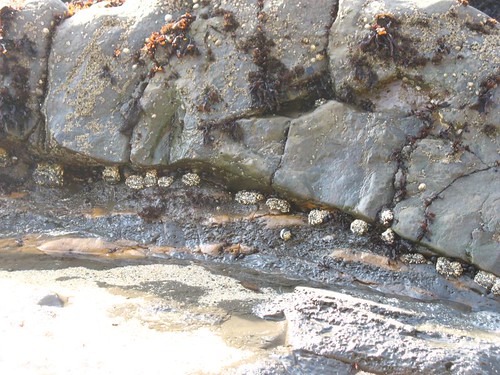
And these sand-speckled things seem to know exactly where they belong, lined single-file in a crack!
Other creatures "sharing" space on this cord of kelp.
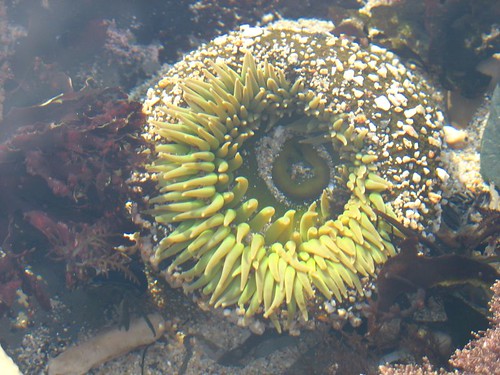
Anenomes are filter feeders. Here are some anenomes nestled in a crevice with water riffling over them. They can filter the organic matter out of the water as it continually rushes over it. I believe anenome reproduce asexually for the most part--an advantage, if you can't get up to find a mate.
These look like snails, but they're hermit crabs, perhaps Pagurus sp. "Life for a hermit crab includes incessant scavenging, either for food or for a home with the proper fit." (Shoenherr)
Green and red algae together. Very different morphologies. One is short and tufted, the other is thin and flat.
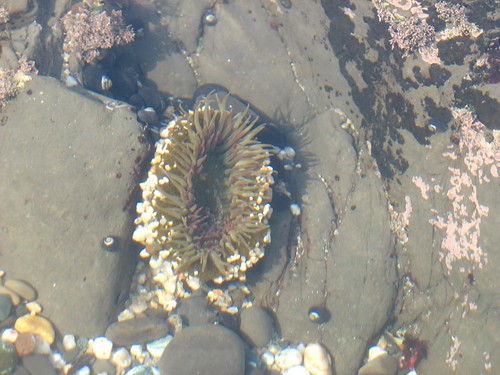
Many anemone.
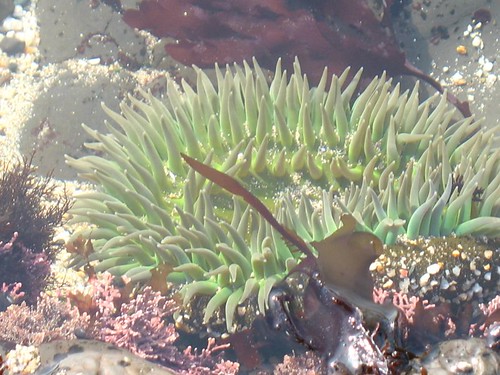
Anenomes living in tight spaces. Do they grow big at their peril, and risk predation or dessication? Is it better to stay small?
Farther out, a harbor seal. They are said to like protected bays, inlets and river mouths. They are predators in the intertidal zone, but prey in open water.
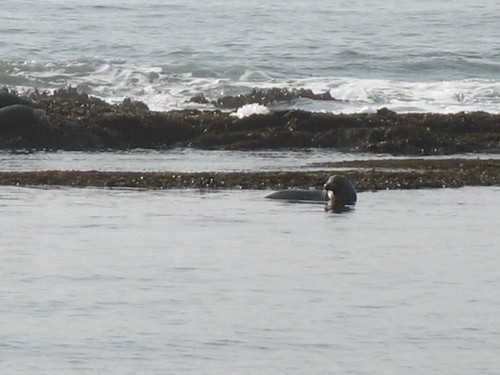
Harbor seals (Phoca vitulina) are distinguished from sea lions (e.g., Zalophus californicus, the most common on the west coast) by having little depressions for ears, and strong hind flippers. Sea lions have visible ears and strong front flippers.
(When you see a seal show at a water park, with clapping "seals" playing with beach balls, those are actually sea lions, not seals. FYI.)
Like Australia and South Africa, climates similar to California's, there are big sharks off these waters, and transient orcas are more and more common according to my instructor. They only eat marine mammals. The residential orcas off Canada's coast eat fish.
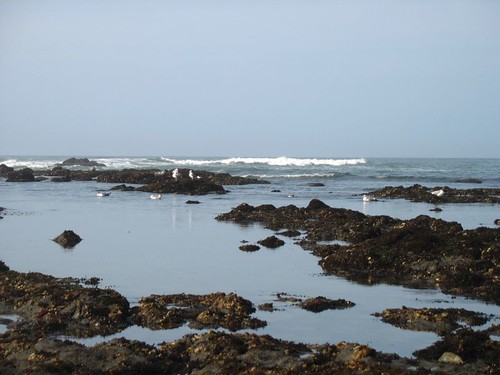
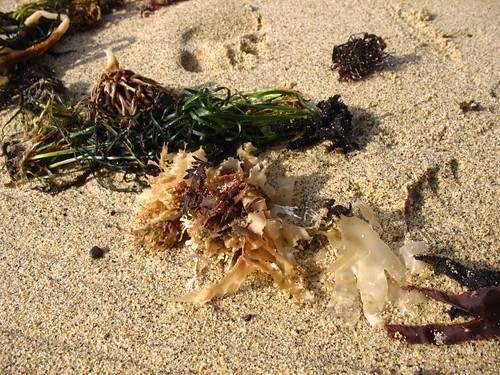
For all the interest in the water, what captures my imagination today are these algal bouquets washed upon the sand.
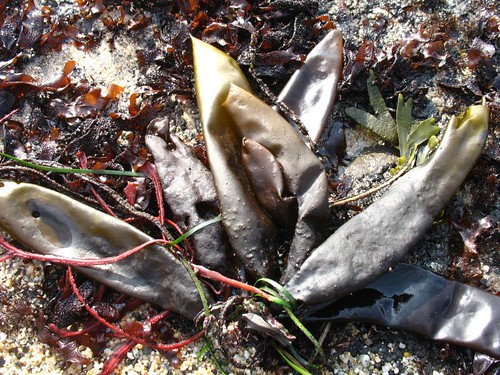
So many different kinds, all knotted together.
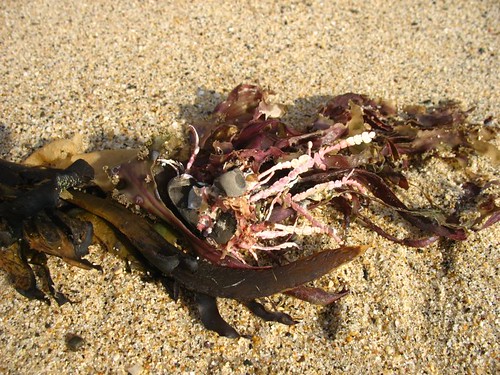
You can see how closely they once shared space under water.

"A number of scavengers live among these piles of rotting kelp..." (Schoenherr)

A gardener would intuit as much. This is bascially compost material.
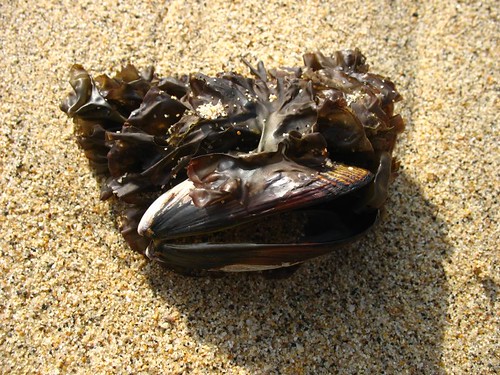
Except that it's not decomposing a pile.
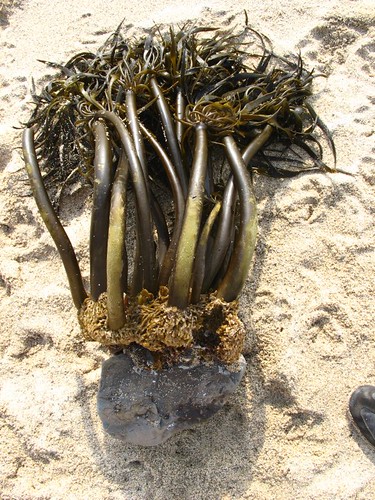
This is Sea Palm, Postelsia palmaeformis.
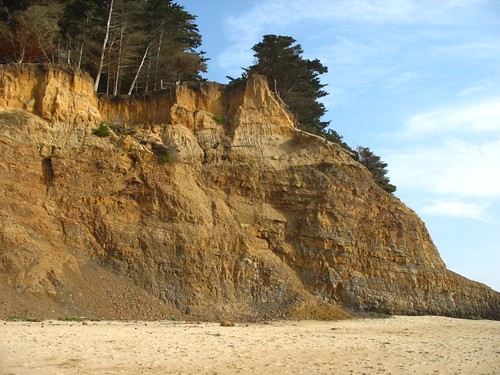
Signs warn of falling rocks, and I could hear rocks falling off the cliff during the whole visit. You can imagine this is a problem for people who choose to live here.

Many people do.
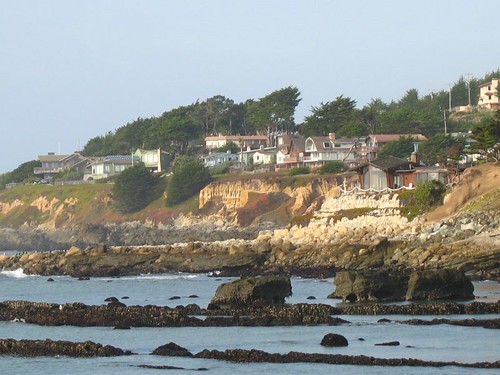
Talk about creatures sharing space...
Intending to counteract coastal erosion, people brought in this African (or is it Chilean?) iceplant Carpobrotus edulis syn. Mesembryanthemum edulis.
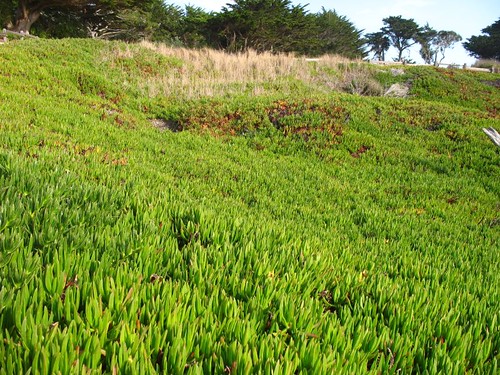
The result has been a net negative for California's coastal biodiversity, and I doubt it's done much to stop erosion.
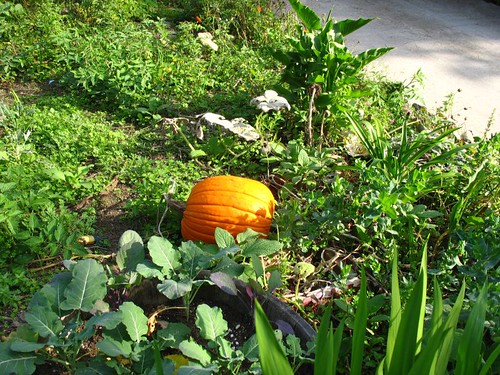
On the way back to the car, I spot a garden...
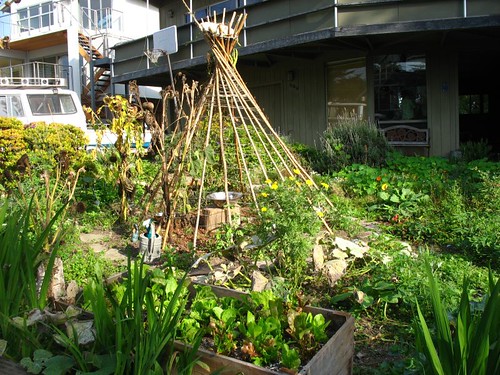
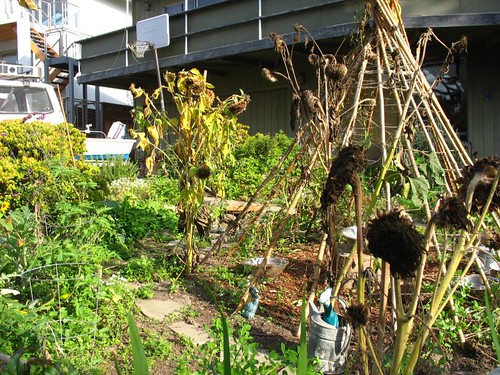
In mild climates, gardeners don't really take down their gardens and put them in the garage for winter. (How depressing!) So there's sometimes a long period of "in-between" depending on your motivation to clean up.
But the winter lettuce is in...
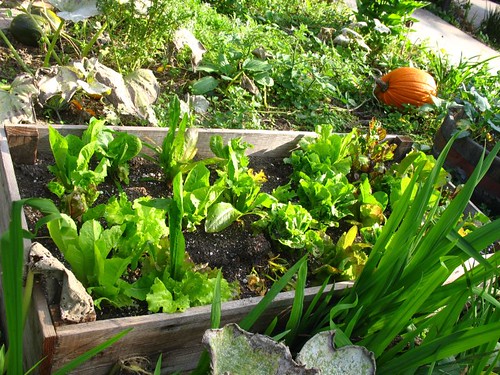
And the pumpkins are ready for harvest.
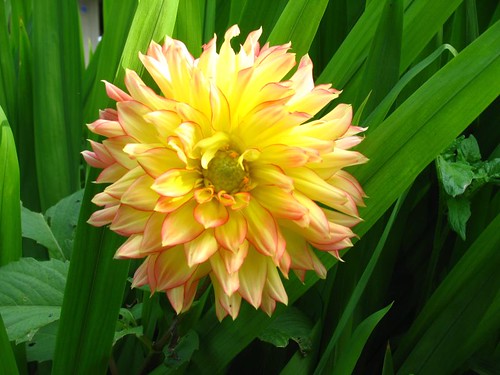
And there are flowers all year long if you want them.
There's more about coastal erosion on the drive home. You can see current progress on the tunnel that will bypass Devil's Slide.
And you can see another noxious invasive plant from South America which has all but taken over all of the coastal cliffs: Cortaderia jubata, commonly called Pampas Grass, although people with more knowledge call it Jubata Grass and reserve Pampas Grass for the cleaner looking C. selloana.
And then you can glimpse on the bridge leading to the other side of the tunnel as we come around the bend.
Did you visit an ecosystem near you and blog about it? Post a link in the comments.
ADDED: The Chronicle ran a story on where to visit tide pools. Link.
So this isn't just a blog post. It's homework.
The Fitzgerald Marine Reserve is in the small town of in Moss Beach, a short drive south down Highway 1 from San Francisco.
If I could sing, I just might join a chorus.
The trees are Cupressus macrocarpa, Monterey Cypress. Moss Beach is about 100 miles north of their native range, which is very limited. These trees have been planted widely in California (and other places), particularly in coastal environments where wind pruning sculpts them into uniquely beautiful specimens. But not here.
The book Introduction to California Plant Life says this:
"[B]oth Monterey Pine [Pinus radiata] and Monterey Cypress--rare and remnant species that are ecologically unsuccessful in their natural habitat--are widely planted as windbreaks and timber trees in many areas of the world, particularly New Zealand and Australia, and...in some of these southern regions, these trees are invasive weeds that have spread from areas in which they were planted to adjacent areas of native vegetation."
The 2001 Sunset Western Garden Book says, "Away from cool coastal winds, C. macrocarpa is very subject to coryneum canker fungus, for which there is no cure. Look for foliage that first turns yellow then deep reddish brown, and falls off slowly. Destroy infected trees."
Like these?
Maybe they have something else; these trees are growing in full exposure to "cool, coastal winds".
But we're not here to see trees.
We've come to observe the tidepools, contemplate California's biodiversity, and appreciate the ecology of the plants and animals that live in this special habitat.
It's about 3:30 p.m., which happens to be somewhere between high and low tide this time of year.
2007-10-27 11:16 PDT 6.58 feet High Tide
2007-10-27 18:17 PDT Sunset
2007-10-27 18:18 PDT -1.42 feet Low Tide
(Link.)
The Reserve closes at 5, and we need to (want to) be home having coctails at 5, so this is the best we can do. (It's funny that Google, and the Blogger spellcheck, want you to spell cocktail with a k, but Wikipedia and quite a few other sources spell coctail with no k. Is this slow evolution into klessness unfolding right before our eyes? What are the selection pressures favoring or disfavoring k?)
But I digress. The point is that during the time of our visit, water is receding back to the ocean.
Water is quite literally seeping out from the sandbank underneath my feet.
Professor Traut's handout for this field trip quotes some text by Bart Oxley and Bob Breen that says "Until its designation as a reserve in 1969, there was unlimited removal of wildlife from its tidepools, and at one time overflow crowds from San Francisco rushed to its shores to experience its touted reputation as a health spa."
Talking to the Volunteer Director at the San Francisco Botanical Garden about this class, I mentioned that we were going to come here on a field trip. He recalled visiting this beach as a child, before 1969, with his father and brother, and collecting crabs and such to take home. It seems so unthinkable now.
But there are a lot of people here today, and I feel certain some of them are collecting.
Don't you?
(As another assignment for the class, we're supposed to write an impact report about how human activities have adversely impacted California's ecology. I'm not going to do that assignment, but if I was going to, it might be interesting to write about how visitors to parks and nature reserves impact those places.)
But what's a reasonable, practicable solution to that problem? I don't know.
Anyhow, let's get on with it already.
Ecologists describe this environment as the "rocky intertidal". They divide the rocky intertidal loosely into different zones...
the splash zone: wetted by surf spray during high tide
the upper intertidal: covered during most high tides
the middle intertidal: uncovered by many but not all low tides; covered by all high tides
lower intertidal: exposed only during the lowest tides
Splash and High:
Middle:
Lower:
Of course, it's very clear where the rocky intertidal meets the sandy shore. I'm starting to think how interesting that is, that these two different environments abut each other so sharply. Such crisp borders are not often found when you think about it.
My class notes say, "Many small invertebrates live in between sand grains, lots of filter feeders (sand crabs)". I'm curious what it's like beneath the surface, where the sandy shore meets the rocky intertidal.
Judging by the animals that are visible in the pictures below, I would guess we're seeing the lower intertidal zone during this visit to the Reserve.
"The lower intertidal is exposed only by the lowest of the low tides, the spring tides. Its upper margin is considered to be the average sea level, the line from which the height of a tide is measured. A low tide that drops below this line is called a minus tide. During a 6-foot tide, this line would be 6 feet underwater." (Schoenherr's Natural History of California)Tide levels vary all over the earth, and some places only have one high tide and one low tide. The two daily high and low tides on the east coast are pretty much equal, but that is not the case on the west coast. Here, one high tide is higher than the other, and one low tide is lower than the other.
Time plays an interesting role in the rocky intertidal's biotic zonation. If you consider a mountain ecosystem, altitude and longitude distinguishes the alpine, subalpine, upper montane, and lower montane zones. Seasonal progressions bring change, but the zones remain more or less fixed geographically from day to day and year to year. In the rocky intertidal, zonal qualities change radically from hour to hour, every day, always.
Living in the rocky intertidal means being ready to cope with relatively extreme variations in water cover and dessication, exposure to predators, temperature, and wave action.
One of the things I've enjoyed thinking about in this class is the importance of space as a resource for living things. Living things take up space. Space is limited. How effectively an organism, or species, occupies and utilizes its space determines whether it gets to continue living there.
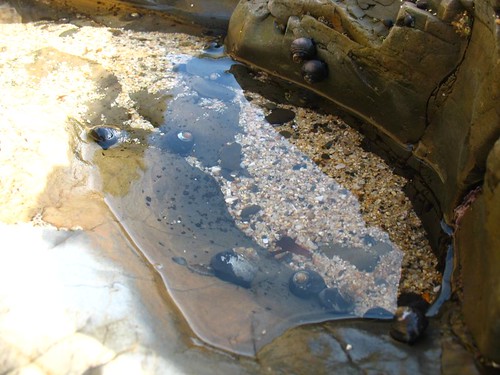
Competition must be fierce--especially in this environment, where the volume of living space contracts to a very small size indeed. This tiny pool will just get smaller in the next few hours as water evaporates.
This tight little crevice is filled with creatures vying for space.
But then there are relatively big pools, nearly vacant.
Do you get more protection in a tight crevice than a big, open pool? Is that what explains the difference in population density? Or is this just random? If I observed this one pool every day during low tide for a year, how would it change?
Two kinds of limpet vie for space here on top of this rock, in the upper intertidal zone. The gray little volcanoes are Chthalamus sp., commonly called Buckshot Barnacles. The little black snails are Littornia sp., commonly called Periwinkles.
Chthalamus use a feather-like hind appendage to feed when the tide is in, and close up when the tide is out. They seal in water and resist dessication longer than the barnacles that grow lower down.
It seems like Chthalamus is winning the battle for space on this rock, but who can say. The flattened cone shape of barnacle shells helps to disperse the energy of crashing waves.
"Periwinkles have an interesting set of reflexes that brings them back to their normal habitat in the upper intertidal or splash zone [when waves knock them off their perches]. When they are underwater, they respond negatively to gravity. This instinct, known as negative geotaxis, causes them to crawl along rocks upward to the surface. If the snail crawls into a crack, when it is right-side up it has a negative reaction to light. If it is upside down it has a positive reaction to light. These instincts are known as positive and negative phototaxes. The result is that cracks pose no problem. A snail crawls into the crack and back out again, always moving upward. Once the snail emerges from the water it knows it is 'home'. As long as it remains moist, it will move only to feed." (Schoenherr)
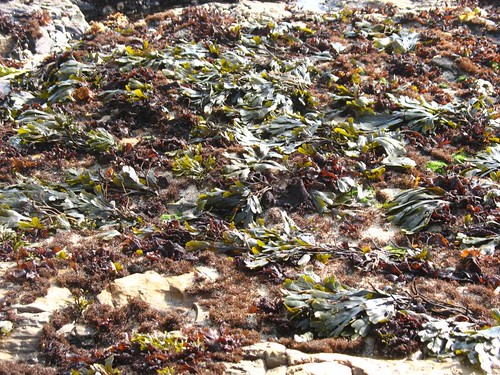
Red algae (Phaeophyta) typically grow deeper in the water than green algae where it effectively absorbs deeply penetrating (short wavelength) light at the blue end of the visible spectrum.
This kind looks strongly attached to the rock to better resist wave action. Note that its growth does not extend into the perpetually wet lower areas.
It's limited to the surface which dries out between high tides. The coarse, leathery texture resists dessication.
Other kinds of algae can occupy the submerged bottoms. The brown algae in this picture is long and filamentous. I would guess it has a higher surface area overall than the flattened kind in the drier zone above.
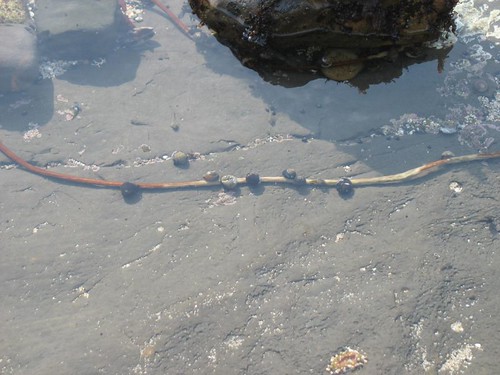
And these sand-speckled things seem to know exactly where they belong, lined single-file in a crack!
Other creatures "sharing" space on this cord of kelp.
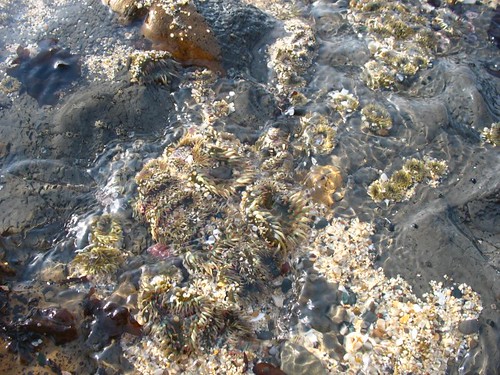
Anenomes are filter feeders. Here are some anenomes nestled in a crevice with water riffling over them. They can filter the organic matter out of the water as it continually rushes over it. I believe anenome reproduce asexually for the most part--an advantage, if you can't get up to find a mate.
These look like snails, but they're hermit crabs, perhaps Pagurus sp. "Life for a hermit crab includes incessant scavenging, either for food or for a home with the proper fit." (Shoenherr)
Green and red algae together. Very different morphologies. One is short and tufted, the other is thin and flat.
Many anemone.
Anenomes living in tight spaces. Do they grow big at their peril, and risk predation or dessication? Is it better to stay small?
Farther out, a harbor seal. They are said to like protected bays, inlets and river mouths. They are predators in the intertidal zone, but prey in open water.
Harbor seals (Phoca vitulina) are distinguished from sea lions (e.g., Zalophus californicus, the most common on the west coast) by having little depressions for ears, and strong hind flippers. Sea lions have visible ears and strong front flippers.
(When you see a seal show at a water park, with clapping "seals" playing with beach balls, those are actually sea lions, not seals. FYI.)
Like Australia and South Africa, climates similar to California's, there are big sharks off these waters, and transient orcas are more and more common according to my instructor. They only eat marine mammals. The residential orcas off Canada's coast eat fish.
For all the interest in the water, what captures my imagination today are these algal bouquets washed upon the sand.
So many different kinds, all knotted together.
You can see how closely they once shared space under water.
"A number of scavengers live among these piles of rotting kelp..." (Schoenherr)
A gardener would intuit as much. This is bascially compost material.
Except that it's not decomposing a pile.
This is Sea Palm, Postelsia palmaeformis.
"It is an annual species that is torn loose by the surf during fall and winter. Each year, about February, a new forest of Sea Palms grows on bare surfaces produced by disturbance... Studies of primary production in Sea Palms indicate that the intertidal region is one of the most productive ecosystems on the planet, producing more biomass per year than a tropical forest. A grove of Seal Palms fixes about 32 pounds of carbon per square yard of surface area per year (14.6 kg/m2/yr)." (Schoenherr)The rocky cliffs are slowly giving rocks back to the ocean. This is chert, a sedimentary rock formed from dead sea creatures deposited on the ocean floor and lifted by plate subduction and translocation millions of years ago. (This whole area of California was at least 200 miles south of where it is right now only 25 million years ago.)
Signs warn of falling rocks, and I could hear rocks falling off the cliff during the whole visit. You can imagine this is a problem for people who choose to live here.
Many people do.
Talk about creatures sharing space...
Intending to counteract coastal erosion, people brought in this African (or is it Chilean?) iceplant Carpobrotus edulis syn. Mesembryanthemum edulis.
The result has been a net negative for California's coastal biodiversity, and I doubt it's done much to stop erosion.
On the way back to the car, I spot a garden...
In mild climates, gardeners don't really take down their gardens and put them in the garage for winter. (How depressing!) So there's sometimes a long period of "in-between" depending on your motivation to clean up.
But the winter lettuce is in...
And the pumpkins are ready for harvest.
And there are flowers all year long if you want them.
There's more about coastal erosion on the drive home. You can see current progress on the tunnel that will bypass Devil's Slide.
And you can see another noxious invasive plant from South America which has all but taken over all of the coastal cliffs: Cortaderia jubata, commonly called Pampas Grass, although people with more knowledge call it Jubata Grass and reserve Pampas Grass for the cleaner looking C. selloana.
And then you can glimpse on the bridge leading to the other side of the tunnel as we come around the bend.
Did you visit an ecosystem near you and blog about it? Post a link in the comments.
ADDED: The Chronicle ran a story on where to visit tide pools. Link.
Subscribe to:
Posts (Atom)