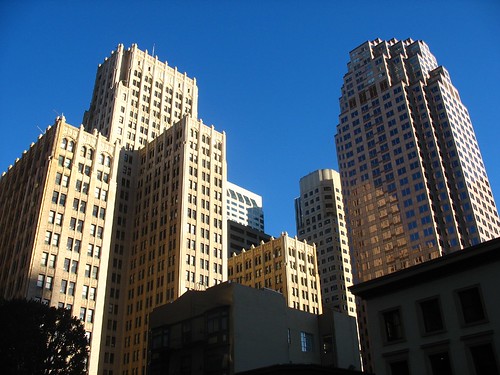
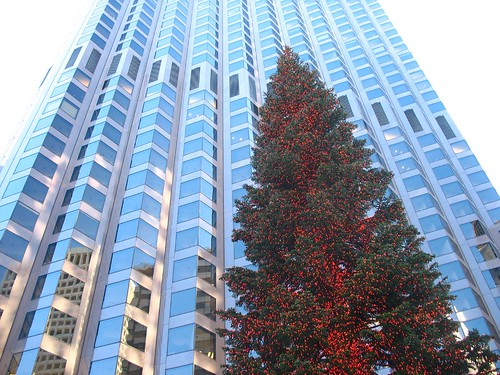
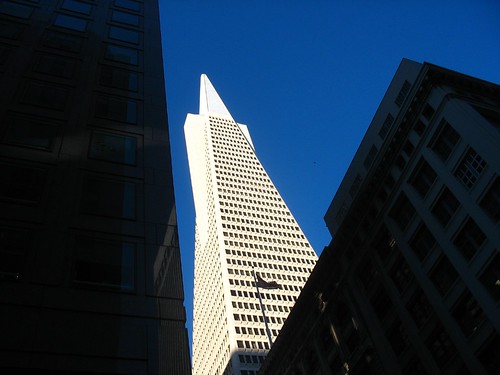
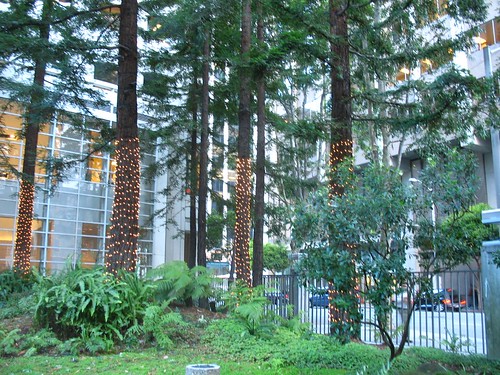
"City Guides got [their] start more than 25 years ago when a San Francisco mayor asked the city librarian to find volunteers to give tours in City Hall."
Today, City Guides offers walking dozens of different walking tours all over San Francisco "focus[ing] on the architecture, history, legends, and lore".
The best part? All tours are free. (Donations accepted.)
That's pretty cool because tourism in San Francisco is not cheap. Tickets for comparable commercial tours would easily start at $30.
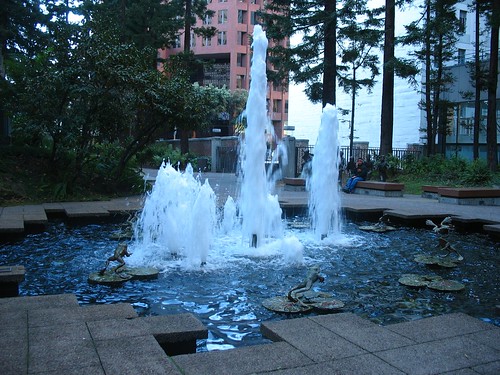
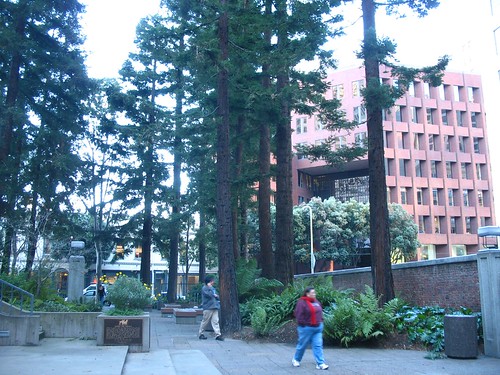
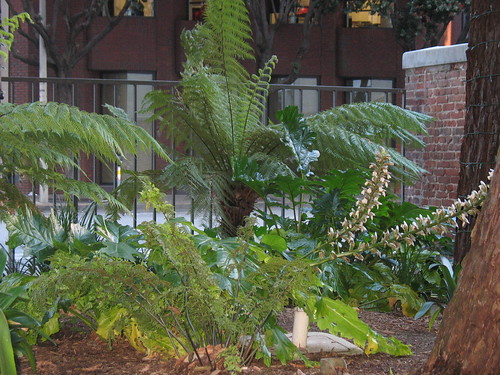
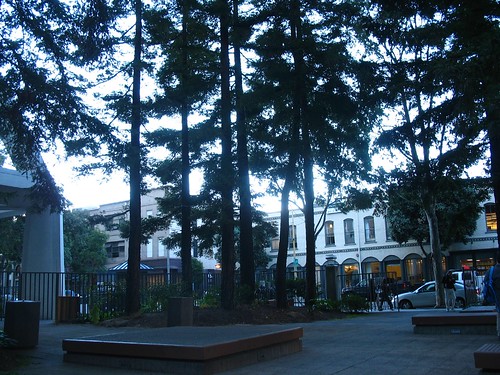
Today, we're going to "discover hidden parks, rooftop gardens, and other delights while experiencing some of the colorful history and distinctive old architecture of San Francisco's financial district."
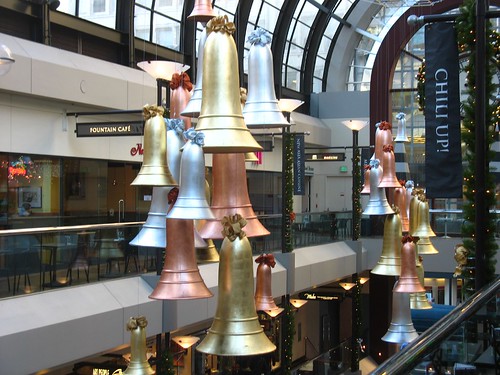
And why not. San Francisco's getting all tricked out for the holidays.
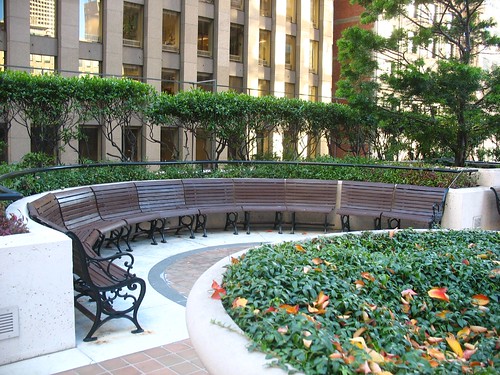
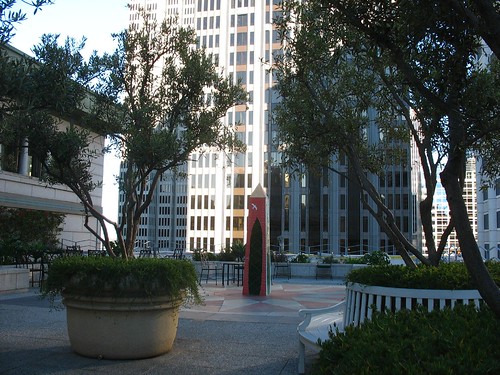
The roof garden at Montgomery and Market. I've always wondered how to get up here. The entrance is through the Galleria next door.
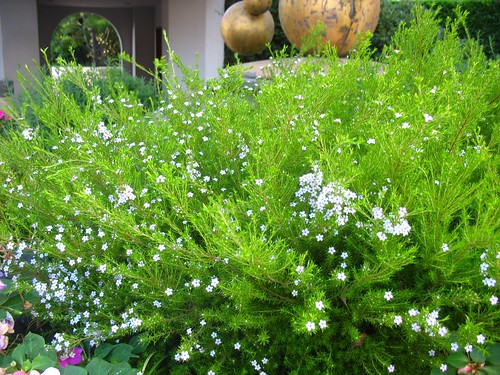
Coleonema album, Rutaceae. I like this plant. The foliage has a spicy fragrance.
You can get a good view of the Palace Hotel from up here--formerly the Palace Sheraton. I'm going to take the City Guides tour of that too.
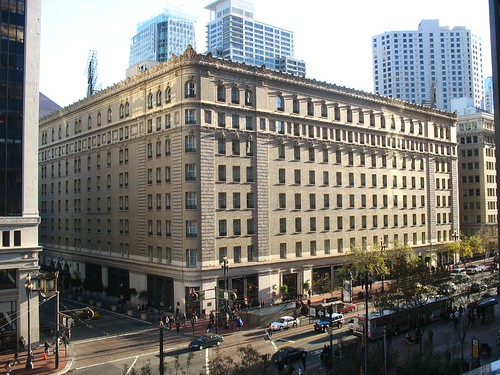
And you can see this building...
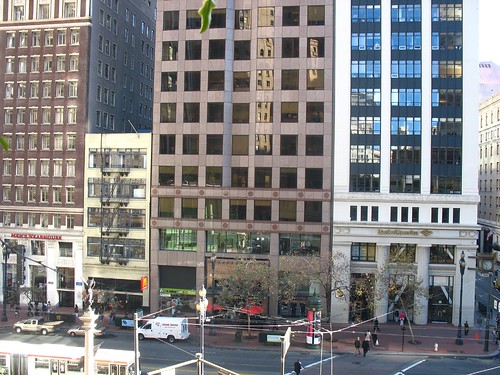
which is built entirely around this smaller building...
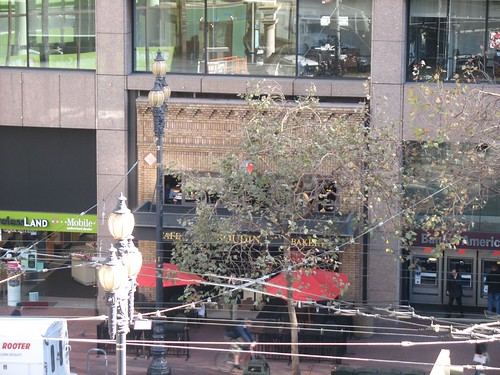
and I've never noticed that before although I've walked right past it hundreds of times.
Moving on...
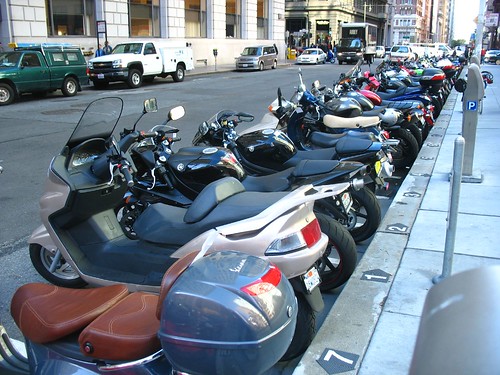
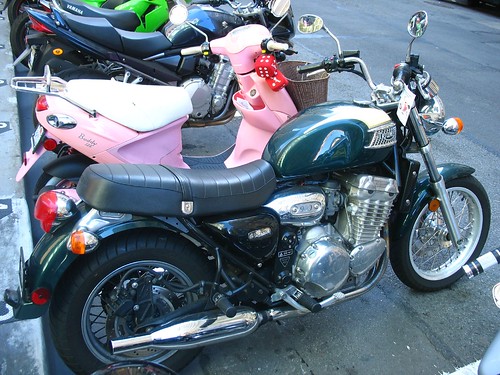
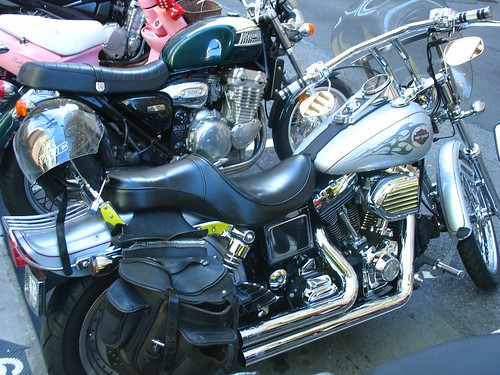
I didn't know Evel Knievel died today when I took these pictures of motorcycles.
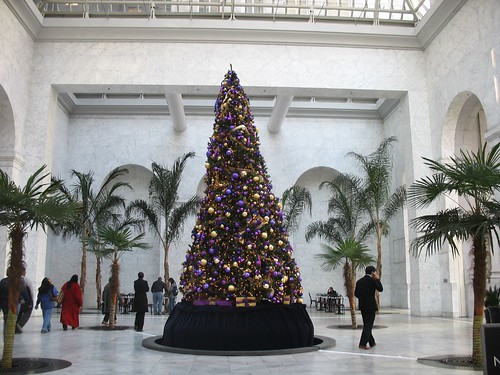
(The tree is actually crooked, not the photographer.)
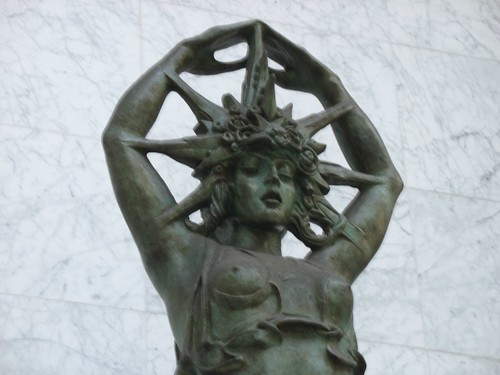
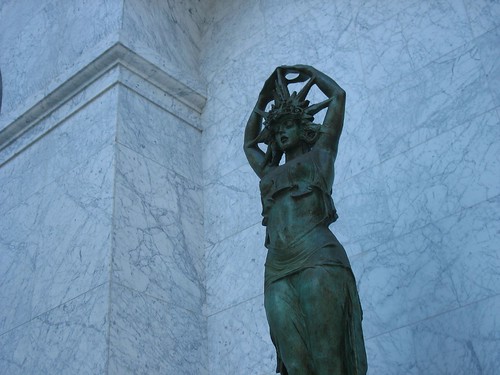
And this is Star Girl.
I was too busy taking pictures to pay attention to the historical narrative, or even to pay attention to where we were exactly. The guide took us into dozens of public buildings I never imagined entering by myself. I took a lot of pictures, including stuff that had nothing to do with the tour.
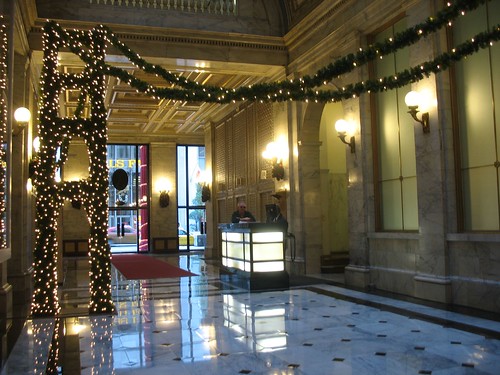
San Francisco has amazing old banks with incredible features and flourishes. Unfortunately, they don't want you taking pictures.
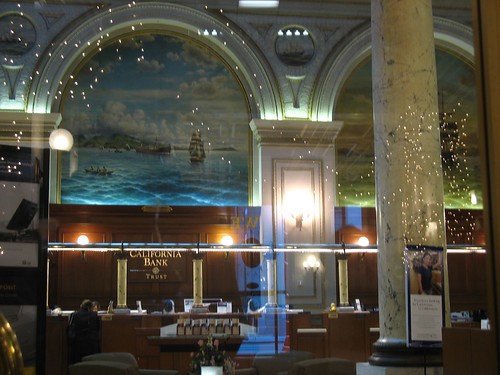
And many of the pictures I took anyway were too blurry to use. Heh, heh. But this one's okay.

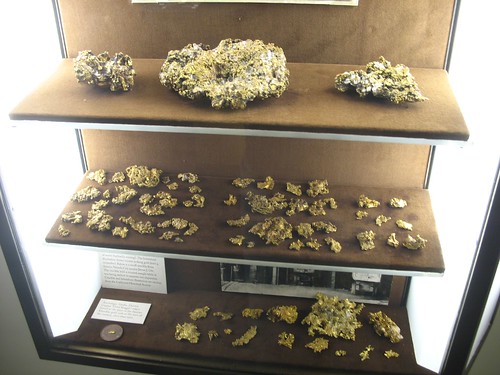
The tour was full of interesting nuggets. Seriously. This is a "money museum" in the basement of an old bank.
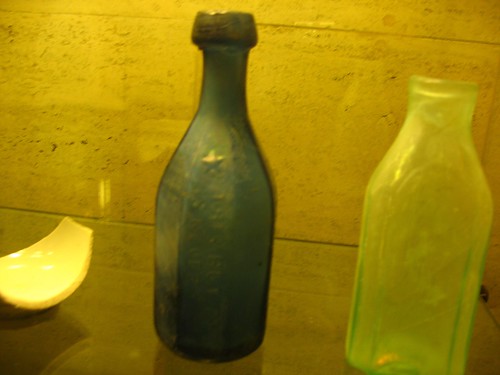
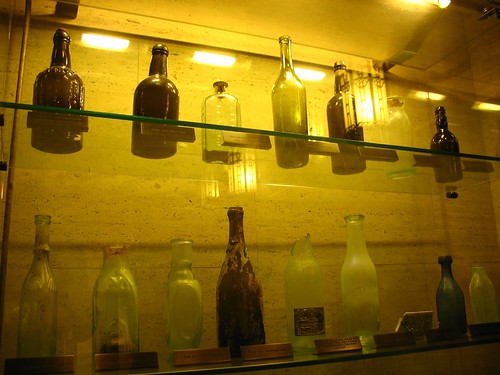
And these are some relics from a pre-1906 apothecary shop found during a building excavation some years ago.
More roof garden action.
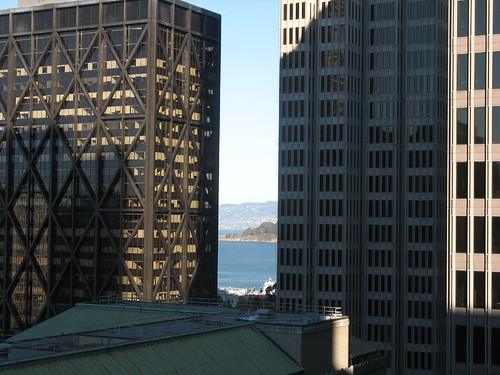
Every once in awhile you catch a little glimpse of the bay between the buildings.
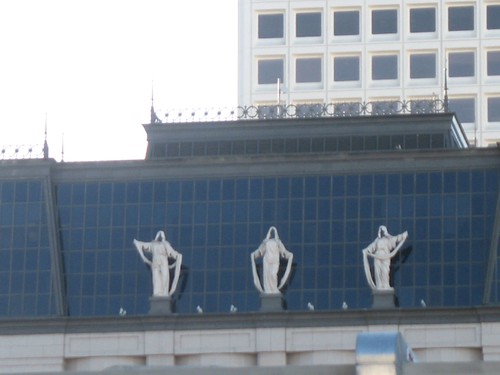
And I learned these statues (which I like, but which many consider tacky) are made out of styrofoam so that if they fall, hopefully noone will die.
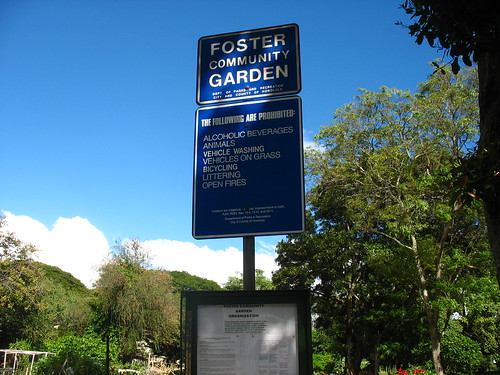
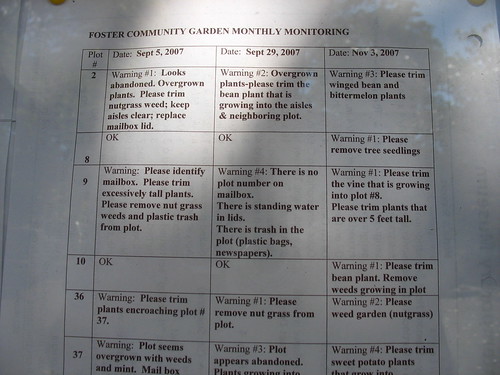
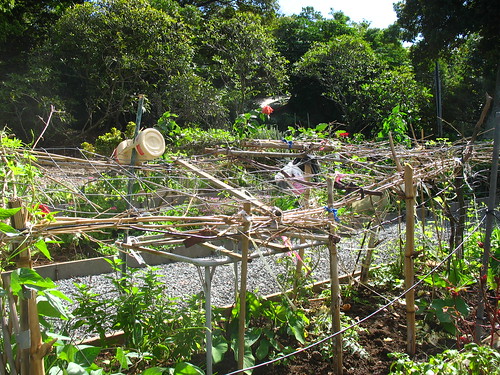
Apparently, maintaining your garden plot is vital. Guy loved this sign; he wanted to move here and be in charge of it.
At first I thought this was a little over the top. But after I thought about it, I realized the growing season is 365 days long in Hawaii. If you don't stay on top of the garden chores, things could get out of control pretty fast.
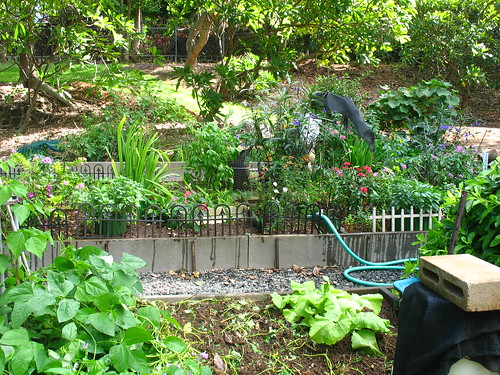
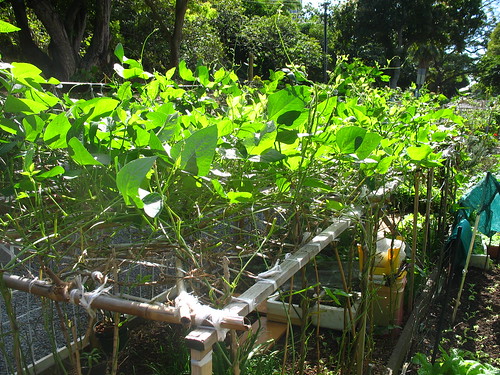
Let's take a look at what people are growing.
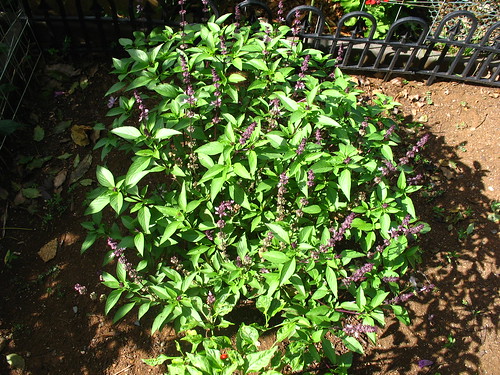
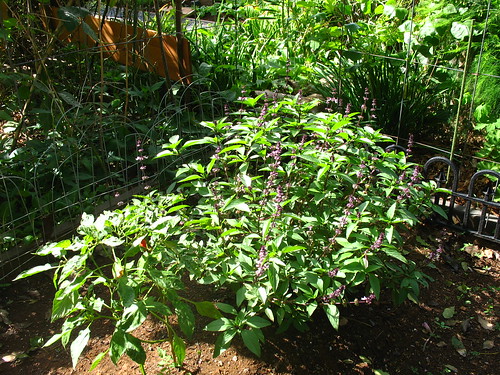
Ah, I grow this in my garden.
'African Blue' basil. Do you grow this too?
Ordinary basil, Ocimum basilicum, is an warm season annual that likes a little more warmth than San Francisco summers have to offer. It will grow here, but a lot of people grow this hybrid perennial instead, or as a supplement. In addition to potager service, it has showy flowers that attract bees. (I actually have a variegated form.)
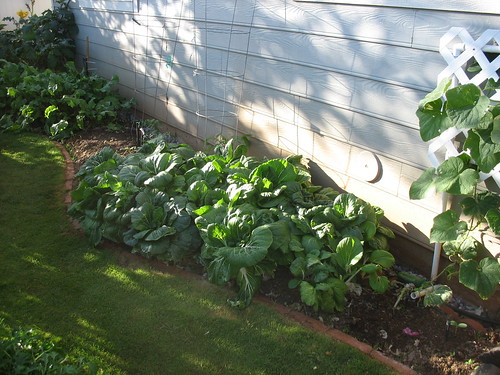
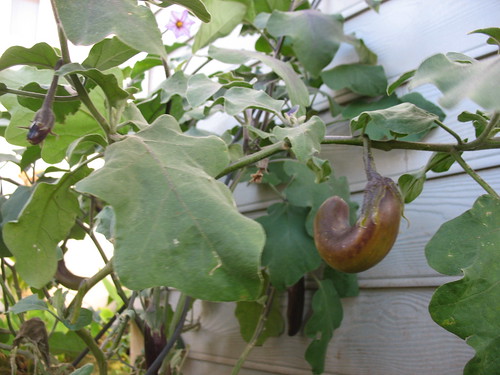
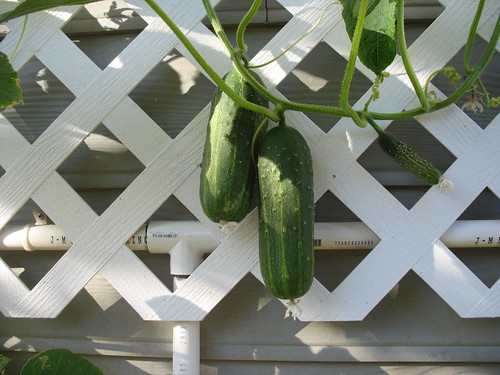
So that's community gardening Honolulu. Let's now turn to home gardening. Guy's nephew's sister-in-law and her husband own a house in a very prim and trim development on Oahu's western side. They have a small garden, and grow some vegetables. (His name is Dave, so you could say this is, wait for it, Dave's garden!)
Seems like an innocent enough little garden, doesn't it? Well, it's illegal! Their neighborhood association forbids vegetable gardening! I can't imagine why. Produce in Hawaiian markets, shipped from the mainland United States, or wherever else, is expensive and shabby. Banning vegetable gardening seems downright un-American to me.
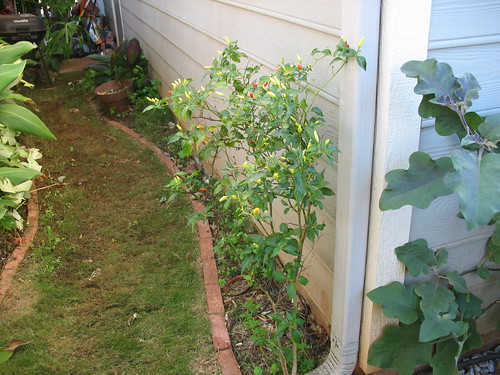
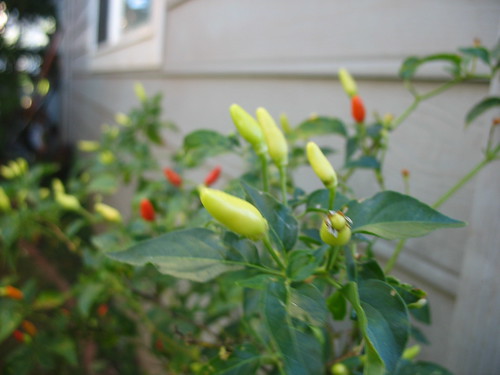
This pepper plant volunteered.
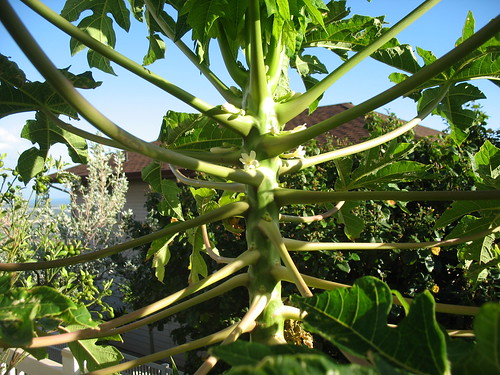
And this is papaya. Papaya with lemon juice is my favorite Hawaiian breakfast.
The brochure says "more than 75,000 visitors view the gardens annually" and I think that's a shame considering that Oahu's population is about 780,000 and five million people visit the island every year. Clearly, word has not gotten out.
I'm NOT starting off with a picture of the information guide crashed out at his desk. Please focus your attention on the fantastic display of nuts and seed capsules that grow here.
You can't grow these things in the temperate zone, and the trees are too big for a small garden anyway. And the trees at Foster are huge. Trees dominate the garden. There are only a few true shrubs and nothing a coastal gardener would recognize as "perennials" (unless I count bromeliads, crinums, and orchids). Mid-level plants are generally aroids and hibiscus.
Anyhow, back to those fruits and nuts:
The visual interest of reproductive parts in this climate is unbeatable. Ahem.
And I'm feeling a lot of love for visual textures here in general...
Dead trunks adorned with bromeliads, mosses, orchids, and tillandsias serve as accent points throughout the garden.
But what impressed me more than anything else was the collection of trees.
Really big trees.
The Oahu County Arborist Committee has designated over 100 trees on the island as "exceptional by reason of age, rarity, location, size, aesthetic quality, endemic status or historical and cultural significance"; 24 of those trees are found in this garden, including enormous specimens of Adansonia digitata (Baobab), Enterolobium cyclocarpum (Earpod), Ceiba pentandra (Kapok), Cavanillesia platanifolia (Quipo), and most impressive during my visit, Couroupita guianensis, the Cannonball Tree.
And they mean it.
The garden brochure: "This member of the Brazil-nut family (Lecythidaceae) is native to Guiana. Note that the flowers are borne only on special stems on the main trunk. The heavy spherical fruit gives rise to the common name."
Besides being large and interesting, the flowers were powerfully and sweetly fragrant.
Finally, a post about the community garden outside the paid area of the Foster Botanical Garden.
We spent Thanksgiving weekend visiting Guy's nephew in Oahu. We visited the Koko Crater Botanical Garden in the southeast corner of the island, about 10 miles east of Diamond Head, and a mile north of Hanauma Bay (as the nene flies).
This is a dry landscape in a southern rainshadow. The garden is young, admission is free, and tours are self-guided. The collection features bouganvillea, plumeria, dryland palms, cacti, cycads, and a grove of young baobab trees (among other things). Many of the most of the interesting specimens have accession tags.
Here are some pictures.
Here is the plumeria's fruit--elongated capsules, 10 inches long--but I still can't figure out the sex parts.
Euphorbia milii. You can grow this outdoors in San Francisco (and I do), but it's so much more impressive in low desert gardens.
Agave attenuata. I was surprised to see this plant all over Oahu, because I've never seen it in Kauai (the Hawaiian island I visit most often).
What looked like some Euphorbia hung from trees like Spanish Moss.
This went on for acres.
(Note Nolina texana in the background.)
Even small baobabs (Adansonia) make very impressive specimens, and Koko Crater has dozens.
I'll be excited come back here every few years to monitor their progress.
A couple days later we visited the Foster Botanical Garden, Hawaii's crown jewel of botanic gardens.
11/24/2007
An article about perennial vegetables, with lots of links.
that I have absolutely no interest in ever reading about or seeing pictures of, ever. For the rest of my life.
For whatever reason, the media seems intent on manufacturing and servicing a desperate need in the heart of every man, woman, and child for new news about John Kennedy and Jackie O.
I want to a lone voice speaking truth to power (into the ethereal nothingness of the Internet): No, I am not interested. I do not care. I have never cared. I will never care. Seeing pictures and headlines about these people make me want to flee. I very much doubt there are two people in the world that I would be less interested in reading about or seeing pictures of.
I just want that to be clear.
Living with a vegetarian, it's no surprise that I've eaten at every vegetarian restaurant mentioned in this New York Times article Expanding the Frontiers of the Vegetarian Plate, currently ranked #7 on that website's list of most e-mailed articles. I can think of a few more vegetarian restaurants to choose from in San Francisco, but the article got all the big ones.
The one I would most like to get back to some day is Cha-Ya. We ate there once when it first opened.
I can only imagine people who don't live here must find the critic's description of the Cha-Ya dining experience quite...amusing. (I know it makes me laugh, and I live here.)
Starting with shira ae ($5.50), a salad of blanched and delicately pickled vegetables served atop a thick sesame tofu dressing. Slices of lotus root and rubbery yam cake added a seafoody aroma to the beans, pressed spinach, shiitakes, and rapini. Cha-Ya's kitchen is adept at imparting umami flavors without resorting to the usual fish-based ingredients. The miso soup was richly savory, and the Cha-Ya roll ($6.75), a lightly fried inside-out roll of asparagus and carrot drizzled in thick, sweet sauce, was deeply satisfying.
Each dish was perfectly prepared. The vegetables in the sushi rolls (we had asparagus, eggplant, mushroom, and rapini nigiri rolls ($3.50 each), and avocado and mushroom uramaki ($5.25) had been cooked to the moment of perfection. A bowl of kinoko udon soup ($7.75) was heavy with chunky mushrooms: enoki, shimeji, oyster and shiitake. The broth, and the noodles, were good enough to imagine climbing into the big stoneware bowl.
Guy hated Cafe Gratitude (too hippy-dippy), but I went to UC Santa Cruz. I graduated with an abiding revulsion of the Grateful Dead, but crackers of dehydrated raw seed, and cheesecake dyed with green algae? No problem.
As far as food goes, I'm much more adventurous with vegetarian fare than I ever am with meat. I will at least try anything that grows out of the ground (or grew on something that grew out of the ground, e.g., fungi). But never will any dead animal creature's liver, kidney, heart, brain, foot, tongue, stomach, intestine, or any reproductive organ, ever pass my lips.
Bad news: I splattered my whisky and setlzer on my computer keyboard a couple days ago, and had to send it in for service. In the meantime, how to get pictures from my camera onto Guy's computer is not immediately obvious. So blogging will be slow for the next few weeks. Plus, I'm going to Hawaii next weekend. Hopefully I'll have Bloom Day up in the next couple of days. Monday at the latest.
Fortunately, this is not exactly a thrilling month for flowers in the garden. I have a lot of purple heliotrope, two abutilon (one white, one apricot), purple penstemon, and a scarlet epilobium all in full bloom. The Hardenbergia vine is pregnant with buds, and the manzanita flower buds are starting to swell. Tibouchina urvilleana responded to a heavy tip pruning by making dozens of new buds.
The kittens love to snuggle up on my feet. They do this when I'm on the bed or couch with my computer, surfing. I feel like I shouldn't move. That's fine, except that I have to pee right now.
What a life.
Penny, wake up! I have to pee!
Pretty much the only time I can get a picture of Miss Patty in focus is when she's sleeping.
We got 1 inch of rain last night. The forecast called for 0.1 inch; I think we always get more rain than the forecast calls for.
I won't be able to use these roses for Bloom Day. Better take a picture now.
There's a slight chance I'll have Hardenbergia violacea 'Happy Wanderer' in bloom by the 15th.
Can you see all the buds?
Not so for Cobaea scandens, which only in the last few months has grown at the rate I expected it to grow all along.
I grew this plant from seed, which I do not recommend. I had a hard time getting any germination. I think I sowed 10 seeds, and I got one plant. Many gardeners grow Cup-and-Saucer Vine as an annual. Unless we have an unusually cold winter, it should live from year to year in San Francisco.
The cymbidium orchid is sending up a flower stalk. This is a division I made from a plant I received as a gift.
"The British imported them from the jungles of Asia and have been growing them in greenhouses for the past two hundred years. During World War II many cymbidiums were sent from England to Santa Barbara to protect them from bombing raids. In Santa Barbara it was soon discovered that the cymbidiums did better outdoors than in the greenhouse. When the war ended, the cymbidiums had multiplied and thrived so well in California that many divisions were kept when the originals were returned. They have been favored by California gardeners ever since."
Some narcissus are emerging...
And I dug this thing up from behind the bamboo. It's growing from a tuberous root or rhizome. I don't know what it could be.
I assume this is sweat pea. I think I sprinkled some wildflower seeds in here too tho'.
I have carrots, onions, peas, radishes and salad greens in the vegetable garden right now--and potatoes up at the pea patch.
This radish is pretty, but tasted bland. Maybe because of the rains last night? Or maybe it's just a bland variety. Or maybe it wasn't ripe. I bought it for the pretty picture on the seed packet.
It's not all spring-y.
I'm getting an unusually dark color on Vitis californica 'Rogers Red' this year.
Absolutely noone will lose a job over this. A container ship rams the Bay Bridge, spills 58,000 gallons of oil in to the bay, and people dawdle. No problem!
What does it take to get fired these days anyway?
I'm so furious I can't even tell you.
Emergency officials were pressured Thursday to explain why it took them hours to announce that 58,000 gallons of oil had leaked from a container ship that rammed the Bay Bridge on Wednesday - creating a slick that has contaminated beaches and injured hundreds of birds from Hunters Point to the Marin Headlands and out to the Farallon Islands.
San Francisco officials, frustrated that they weren't told immediately about the severity of the spill, threatened legal action against the company or agency responsible for the disaster.
(Link to the Flickr set if the blog page loads too slowly for you.)
I haven't been to the Japanese Tea Garden in Golden Gate Park in about 25 years, even though it's right next to the Botanical Garden and I go there all the time.
In fact, I was at the Botanical Garden today for a this volunteer appreciation luncheon. I love this place and these people. As far as I'm concerned, I'm honored to volunteer here and I don't need to be feted. It was great to see everyone today and reconnect with some people I haven't seen in over a year.
We had delicious Asian cuisine and of course lots of wine. Seating places were set with plants in 4" pots that attendees could take home. I got a rooted cutting of Luma apiculata!
This is one of my favorite small trees. I included a picture of L. apiculata in a post from last July.
Warmed by good food (and wine), I was ready to visit the Japanese Tea Garden on this cold, cloudy fall day.
The structures loom over the garden fence from a ways away.
The garden dates from 1893 when it was built as part of a Japanese village exhibit for the Midwinter International Exposition of 1894. A brochure I bought at the gift shop details the history of the garden which becomes especially interesting during WWII when the descendants of the builder, Makoto Hagiwara, were evicted from their residence in the garden. You can read the brochure here if you're interested.
According to many sources, this is the oldest public Japanese garden in the United States--which begs the question, where is the oldest private Japanese garden in the United States?
58,000 gallons of oil [approx. 1871 barrels] were spilled in to San Francisco Bay last night when a tanker collided with the Bay Bridge in fog.
"This is peak migration season for birds, and all the birdwatchers are excited about it - so it's at a particularly bad time," she said. Voice breaking with emotion, she added, "It's disturbing. These are all beaches that I love and spend a lot of time at."
Coast Guard officials said 16 beaches have so far been contaminated and closed off, and large patches of oil are floating on the bay. Beaches closed including Baker Beach, China Beach, Keller Beach, Point Isabel, Ferry Point, Caesar Chavez, Crissy Field and Fort Point.
Along Rodeo Beach in the Marin Headlands, National Park Service ranger Robert Del Secco kept visitors away from the beach, which is covered in dark clumps of oil.
The pungent oil scent can be smelled around the Bay Area.
My local nursery began their off fall sale today--everything is 25-75% off from now until the place is cleared out for Christmas trees.
I got all these plants for just about $100.
This is all for my dad's garden which I'm going to work on this weekend. I didn't go looking for anything in particular. I just bought some things that caught my eye and that I know will work well in a no-to-low maintenance California garden.
I'll figure out later where it all goes, but how about some quick combinations? Salvia guarantica + artichoke?
"Oh - my –gawd. I have had good chocolate before. I have had interesting chocolate before. I have seen unusual shapes of truffles before. But people, you have to look up L.A. Burdick Chocolate. Elizabeth in Seattle sent us a lovely package of chocolates with the most eclectic flavorings. The one (okay one of two) Mark and I tried tonight was dark chocolate with espresso, anise, and something I forget. It was the most complex and enticing chocolate I’ve ever tasted."
I removed a section of the cobblestone path in my garden, thus eliminating the element of choice. Now it's one-way trip in, and one-way trip back out.
Inadvisable? Perhaps.
I did this for a couple of reasons.
1) I wanted to accommodate the volunteer Geranium maderense whose growth would have blocked the path next year anyway. I decided to keep this plant because I like its structure, particularly in juxtaposition with Echium wildprettii.
Also, insects like to visit the inflorescence and insects are an important consideration for me. Plus it was a volunteer. It was free! And a free biennial at that, which is even better because biennials are like having two plants in one (since the second year is often very different than the first year). I thought about moving G. maderense to a different location, but I decided it had picked the very best place to grow.
2) I wanted to put something green and evergreen between two silver-gray Eriogonum arborescens that flanked the path. Too much silver-gray was a problem in my summer garden this year. I bought a sporty looking Rhamnus californica (coffeeberry) during my visit to Yerba Buena. I tried to grow this plant from seed once, but failed.
This new redesign represents the death blow to any previously expressed wishes on my part for the garden to attain a certain level of completion and exist thereafter as something to be maintained in a state of design climax. As if!
The garden is what it is, and I will continue to tinker with the various elements and respond to the changing needs of the plants as I see fit.
I actually did this work a few weeks ago. I've been rearranging "hardscape" elements in other less impactful areas for awhile now--adding a few cobbles here, deleting some there. The net result has been the liberation of 40 cobbles--too many to store. I held on to 15, and sold back 25 to the stoneyard for $1 each.
In:
Out:
"It's easy to misspell fuchsia, but did you know that it is also commonly mispronounced? Many know this cloud forest exotic as FYOO-shah, but the preferred pronounciation is actually FOOK-see-ah, as it is named after the 16th century German botanist, Leonard Fuchs. The fuchsia is a favorite in Bay Area gardens, and SFBG Plant Sales are a good source for the mite-resistant varieties that thrive here. Fuchsia boliviana can be found in the Meso-American Cloud Forest, the South America Garden and in this month's In Bloom feature, complete with photos, plant profile and exact locations."
That's from the San Francisco Botanical Garden Society's monthly newsletter. I wondered if that was the correct pronunciation for fuchsia, which is often misspelled, or misspelt if you prefer, even on garden blogs (but not this one).
My former boss's boss trained under a man named Fuchs, pronounced Fooks, so naturally I wondered about fuchsia.
It doesn't really matter you pronounce a botanical name, because people from different places speak differently and we're all content with that. I assure you noone at the San Francisco Botanical Garden says FOOK-see-ah unless s/he's joking.
I can only think of one genus name you really want to pronounce a particular way. Do you know which one I'm talking about? It starts with a C.
And it's not Ceanothus. Which is mostly pronounced SEE-a-NO-thus. I want to call it see-ANN-ah-this. That would be my preference.
I had one other thing to say, but someone just called and I forgot what it was. I hate it when that happens.
Now I remember. I was going to say when a genus or species is named after a person, there's a stronger argument for favoring a specific pronunciation. Heuchera is another example. The man's name was Heucher, and you say it HOY-ker. So it would be HOY-ker-a, not HYOO-cher-a or HYOO-ker-a. I've pointed that out many times. But noone cares. It's something I do for me. Pedantry can be fun.
After the Blake Garden, I came here to the University of California Botanical Garden at Berkeley.
We're in the Arid House...
and this is Pachypodium lamerei.
And so is this.
As you can see from the identification tag, Pachypodium belongs in the dogbane family, Apocynaceae, the same family that includes vinca, oleander, and star jasmine. I know all that because I'm super, super-smart. No, I just took a year of Plant ID in the horticulture department at community college, by far one of the best things I have ever done with my time.
Here's another taxonomical surprise. This is a Pelargonium.
See?
That says Pelargonium carnosum.
Oh, my.
This is Welwitschia mirabilis. If you say it does not remind you of a vulva, you either need glasses or you're in denial.
This is a fast-growing vulva. I took this picture of it in September, 2006.
Now it's about to climb out of its planter box and start eating people.
I think this would be a neat houseplant.
It's just called Boophone sp., from South Africa. Amaryllidaceae.
Here's another Boophone, B. haemanthoides.
This is a rather compact-looking specimen of Aloe plicatilis. This is the plant I stumbled over in the field behind the community garden and took a cutting of several months ago. (The cutting is doing well, although I've since bought two more rooted A. plicatilis. So now I have three.)
I'm trying to think of other succulents with attractive fruit. I can't really think of any. Opuntia maybe.
On that note, we're done with the desert, and entering the woods.
The Vitaceae is an interesting family without clear connection to any other family. This is Vitis coignetiae and these leaves are as big as dinner plates. You might know this plant as Crimson Glory Vine. Digging Dog sells this plant.
Less densely foliated this time of year, these leaves seem to hang in the air.
Hydrangea shrubs. Always nice to see in other people's gardens.
Some kind of water iris. I actually think I own this plant, but I don't have it in a pond, so it will never flower and I should probably get rid of it.
The County Clerk started a Flickr Group, Berberine Daydreams, and I added this picture of Mahonia lomariifolia.
The genus Mahonia is in the Berberidaceae, and some think it should be consolidated with the genus Berberis. Whatever.
I didn't realize Berkeley Bot had so many of these Mexican salvia things. I thought Strybing had cornered the market.
They have pretty flowers, but need a lot of development before they're ready for any ordinary home garden. They're huge, rampant things.
I only took pictures of a couple others.
This one's pretty.
Now for some abrupt shifts...
Casurina torulosa.
Beautiful needles.
Beautiful bark.
This is Chayote squash, Sechium edule.
It's an elephant topiary. No, not really. It just looks that way.
Pam Peirce endorses chayote, even in small gardens because it's attractive and climbs. This is a cool season squash that ripens in November and December. In her book Golden Gate Gardening, she writes, "This tropical plant grows from seeds that never become dormant, but just grow out of the mature fruit a few months after it falls to the ground. To start plants, get two or three chayote fruits from another gardener in December or January or buy some at a produce market." I'm pretty sure you can get seeds from Territorial too.
Passion fruit vine, quite dead
and passion fruit.
I like how this combination looks from either side.
But especially this side.
The grass and that...other thing are cool in near proximity.
Lusciousness.
More blooming tree dahlias.
I couldn't decide which picture to use.
These pitchers are from the genus Nepenthes. There's an especially scary one from Borneo called N. hamata, that has "the mouth of the pitcher surrounded by long, curved, knife-sharp hooks. 'One can only guess what this plant may be evolving into,' D'Amato writes in his classic, The Savage Garden. 'Pray that it doesn't start walking.'" (Link.)
Cattleya labiata var. El Dorado
And we end this visit in California, where recent rains have rejuvinated Coreopsis gigantea.
The Blake Garden is only open during regular business hours, so I can only come when I'm not at work.
Happily, I'm off for awhile.
Whenever I have time off work, I ask myself, Can I visit to the Blake Garden?
The answer is always the same.
Yes!
I can't believe the tree dahlias are already blooming in November.
This event is still two months away in my garden.
And I have the double white, which is rarer. I wish I had this more common one instead.
This herb garden looks very exciting. I want this.
Cyclamen massed in the ground is really sweet. Usually you see it in pots, don't you? They don't grow under redwoods in nature, but that's okay here.
I have a terrible time just sitting down in a garden and enjoying a moment. I have to keep moving! It's always afterwards that I wish I'd sat for a minute.
You've seen the Echium wildprettii in my garden, this is another Echium, Echium piniana. E. wildprettii sends up an inflorescent spire from a basal rosette; E. piniana grows 4-12' high on a trunk, and then sends up an inflorescent spire.
Eriogonum arborescens in late summer dormancy... I'm like this plant's patron saint.
I love it.
And this is E. giganteum, next to the green manzanita.
Another place to sit and rest that I didn't take advantage of.
I think the Maytens tree is an interesting mixture of comfort and menace; comforting green leaves rustling in the breezes, swaying on casually weeping stems, menacingly contorted dark wood threatening to poke and grab.
The grasses capture the light and the wind.
Pardon my Piet Oudolf moment.
I like a trellis with many layers like this.
Probably triples the construction cost.
I just think it looks better than a single layer.
If I'd sat down here, I would have stayed until the sun went down contemplating the life of this tree.
Unless it serves as a barrier, I think people plant this Puya at their peril.
It has this flower once in awhile. But if it was my garden, I'd rip it all out.
The manzanita trunk draws the eye from 100 feet away.
On the other side, looking back to where I just was.
This is a classic combination of the California chaparral.
That gray Salvia is dead above ground, and bone dry. The oily resins in manzanita wood burn hot. In California, plant this combination at the back of your property, or better yet, just appreciate it in parks and public gardens. This would certainly be an unwise foundation planting in many situations.
California Highway 116 runs through the small unincorporated town of Guerneville in Sonoma County--a 90 minute drive north of San Francisco (without traffic; easily over 2 hours otherwise).
A sign without periods in the Safeway parking lot tells the history of the place...
Today, this is a popular summer resort area for people in the Bay Area, especially the gays. The Russian River winds through Guerneville on its way from the mountains above Mendocino, and south to Jenner, where it empties into the Pacific Ocean. The downtown has a few bars, some restaurants, and several small art galleries, antique stores, and thrift shops. The vineyards grow Pinot and Chardonnay. The Bohemian Grove is here.
I don't know when the gays started flocking to Guerneville, or what it was like before they did, but up until 1990, I always thought of this as redneck territory.
My mom said she was going up here to visit a lesbian friend from nursing school and I was all, "Lesbians?! Up there?!" and she was all, "Get a clue; it's totally gay up there!"
After that, it seemed like everyone I knew was heading off to the "Rush Riv" for one gay-themed summer festival or another.
It's autumn now and the summer gays are gone.
We have a friend whose dad owns a rental cabin on the river. She has second dibs on the cabin when it's empty, which is often during the fall and winter. We're just here for a couple days.
The mornings begin with my favorite of all vacation breakfasts, pie and coffee.
I've been reading this book on and off for several weeks.
The mornings are slow. I lay outside and read while Guy watches a movie.
Chapter 8 was very good, but it's a little hard to concentrate with all this peace and quiet.
Sequoia sempervirens. No one calls it that in ordinary conversation but me. It's coast redwood, the tallest tree species on earth. A relict from another time.
A little walk?
The cabin is right on the river.
The Bohemian Grove is in the woods on the other side.
(Southern exposure; the sun is in my eyes.)
The river floods its banks during winter rains, so the dock gets pulled up for the season.
It's not all vacation rentals and summer homes. Some people live here all year round.
As a rule, redwood forests mean deep shade on the forest floor. But the sun is low on the horizon this time of year, and the forest has been thinned for residential development. Front yard gardens are a mix of things. I see lots of flowerless rhododendrons. But also Salvia leucantha, some roses, and lots of mostly-spent bedding annuals for part-shade like impatients and begonias.
It's a little depressing to see an environment like this so bereft of native plant species besides the trees. What's missing? Perfectly carefree garden plants with year-round interest such as Giant chain fern (Woodwardia fimbriata), sword fern (Polystichum minitum), evergreen huckleberry (Vaccinium ovatum), Salal (Gaultheria shallon), currants and gooseberries (Ribes sp.), Vine Maple (Acer circinatum, not native this far south, but it would still be nice to see), coffeeberry (Rhamnus californica), tanoak (Lithocarpus densiflorus), Douglas Iris (Iris douglasiana) tiger lily (Lilium pardalinum, well those might be here and be dormant, but I doubt it)...
What's here in nauseating abundance is Algerian Ivy, Hedera canariensis. It sickens me to see it climbing redwood trees and I want to take my pruners and cut it off at the base of every tree I see.
(It's been pruned off these trees; other pictures I took were too blurry to use.)
The architecture and design is all over the place.
It's past noon before we go in to town for some real food.
After breakfast, we mosey around.
These two pictures, above and below, tell you a lot about the Guerneville milieu.
This store, in case you haven't figured it out, would be the one-stop-shop for all your female impersonation needs.
I like to think that at least some of my readers actually do dress like this from time to time. You know who you are.
A fabulous night of liquor and lip-syncing await you!
Or just get dressed up for Ugly Betty at the Rainbow Cattle Co.
Moving on...
I had a hemp shirt once. I think it shrank in the drier or something.
I don't know what that says.
I must say, the chocolate seems like an afterthought at Hemp & Chocolat.
I do enjoy a good truffle.
In other stores...
the Christmas vibe is upon us.
This is my first encounter with the spirit of Christmas(-shopping) in 2007. I can't say it feels all that bad.
I see lots of stocking stuffers.
If I was a chick, or just wanted to dress like one, I'd wear stuff like this.
Tonier fare in a few shops.
I wonder how the kittens are doing.
The neighbor S will visit them tonight for dinner and play time.
These jellyfish glass things are in all the finer crafty stores now. I do like them, but we have nowhere to feature such an objet d'art at the house of whoreticulture.
And I like these very inexpensive baskets made out of dried grasses. But I didn't buy one.
Julie, I rang the gong for you.
Somehow, I forgot to bring socks with me on this trip, so I was glad to see this fishing tackle store had boot socks for sale.
I cannot go without socks at night because my feet get cold. I have big feet, so that means a big part of my body is cold, and that means I catch a cold. And that would suck.
Are you bored yet?
Here I am looking at cards.
October 18 was my birthday.
I'm getting old.
What a lovely garden.
There's a little bit of garden interest downtown too.
This is probably the best use of Lamium maculatum I've ever seen. People plant it with impatients and pansies and I think that's crazy.
I would like to have this wreath of bay leaves. I love bay leaves. California has a native bay, Umbellularia californica. Its fragrance is stronger than the Mediterranean Laurus nobilis and I'm always reading it gives some some people headaches. Not me. I like the California one much better.
Big tits, and what's the nose?
There's a flea market in the Safeway parking lot, and a woman is selling rooted cuttings from her garden.
She had some nice stuff, but her prices were too high. She wanted $10 for six-inch yellow-flowering abutilon in a 4-inch pot, and even more for a small double purple Datura. I didn't tell her that or try to haggle with her. I wonder if that could ever be me--selling cuttings and seed-grown plants at flea markets in semi-weird, semi-rural California supermarket parking lots. It doesn't sound so crazy, but I think I would rather be gardening.