1/15/2007

IMG_6723

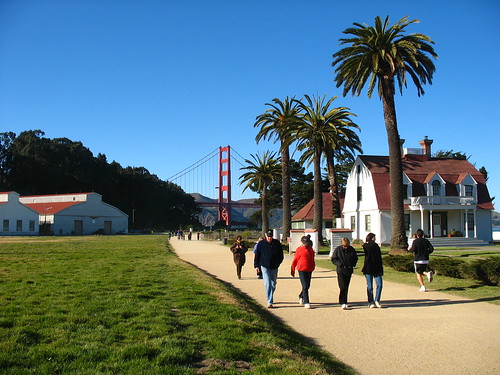
Like a lot of people who live in tourist destinations, I rarely think to visit the beautiful places that make my city famous. The beauty doesn't just belong to me as a San Franciscan or a Californian. It belongs to everyone.

In that spirit, on this MLK Day, would you like to come along for a visit?


You recognize this place, don't you?
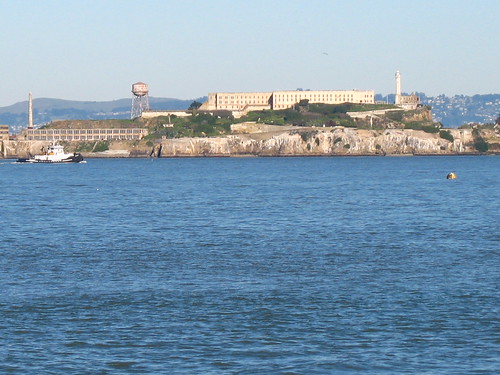
IMG_6706

Alcatraz. My dad's godmother's father was a sign painter on Alcatraz during the entire time it operated as a prison. They lived on the island. My dad's godmother frequently took my dad and his twin brother to stay with her family on Alcatraz for weekends. There are endless family stories about the trouble they got into there.

My grandfather worked for the Department of Public Health when he first came to California. As the county doctor, it was part of his job to operate on Alcatraz prisoners when they needed surgery. I've had all kinds of behind-the-scenes tours of over the years, including the surgery suite where my grandfather operated. The operating tables are still there.

The Garden Conservancy has taken custody of the gardens on Alcatraz and hired a gardener to renovate them. They were once quite beautiful. I would give my eye teeth to have that job some day!

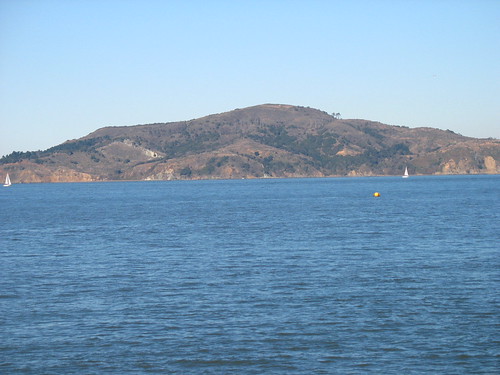
Angel Island. My aunt was a docent there for awhile.
IMG_6708

San Francisco Bay's version of Ellis Island. The government kept Chinese immigrants here for months, years while determining whether or not to grant them entry to America.

Adrienne Rich:
[N]o icon lifts a lamp here
history's breath blotting the air
over Gold Mountain a transfer
of patterns like the transfer of African applique
to rural Alabama
voices alive in legends, curses
tongue-lashings
poems on a weary wall

And when light swivels off Angel Island and Alcatraz
when the bays leap into life
views of the Palace of Fine Arts,
TransAmerica
when sunset bathes the three bridges
still
old ghosts crouch hoarsely whispering
under Gold Mountain


My own San Francisco story is a cliche. You've probably heard it before. I first moved here as a runaway when my father chased me out of the house after finding out I'm gay. I went from being a runaway to being a homeowner. How's that for the American dream?

The dunes at the beach went into restoration in the mid-1990s when the park service took custody of the land from the military after base closures some years before. Volunteers planted coyote bush, lupine, artemesia and coast strawberry. Once upon a time, this was what a lot of San Francisco looked like.

IMG_6717

I love the old military buildings.

IMG_6727

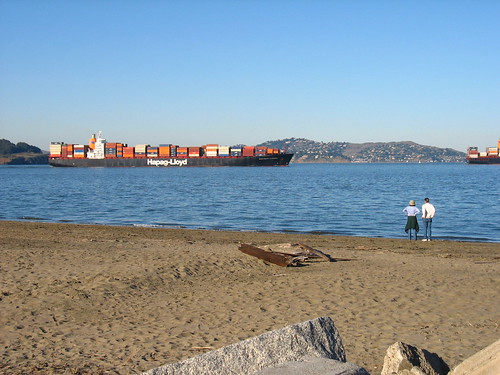
The big container ships sail in and out all day long.
IMG_6753

Other kinds of ships sail in and out all day too.


I highly recommend the bay cruises offerred by the various ferry lines at Fisherman's Wharf. One goes just outside the Golden Gate; it's quite thrilling.

Another time we'll go across the bridge. But this is as far as we're going today.
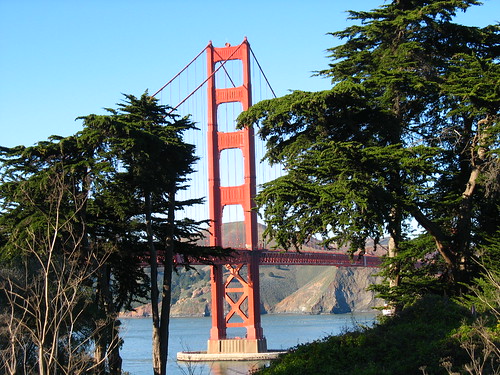
IMG_6741

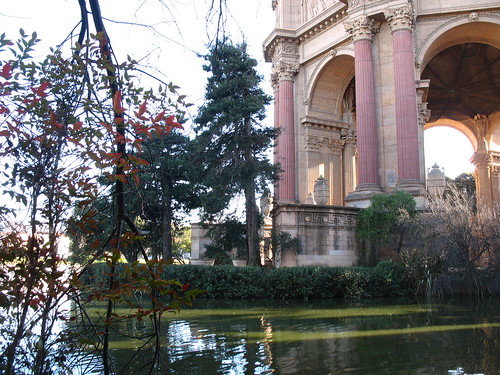
I want to visit the Palace of Fine Arts too.
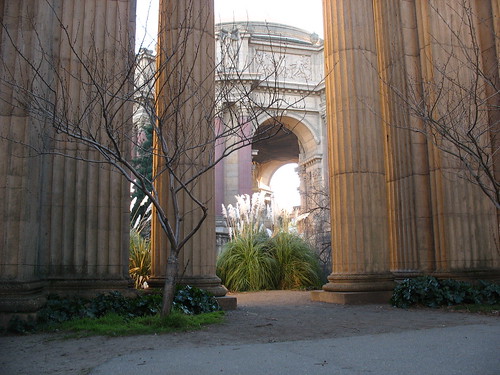
IMG_6756

IMG_6757

IMG_6776

IMG_6759

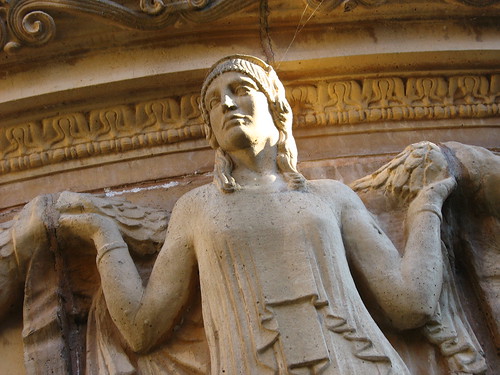
Surely San Francisco's most exquisite landmark.

IMG_6764

IMG_6767

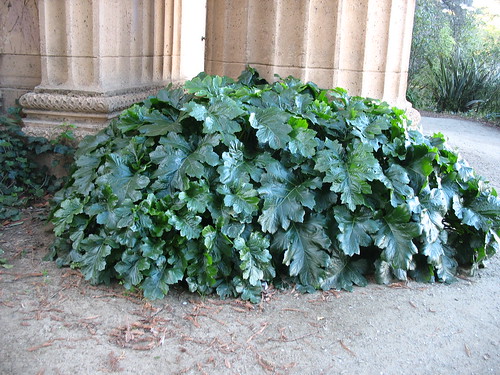
Acanthus mollis planted beneath Corinthian columns!
IMG_6777

This is the plant whose foliage inspired the Corinthian capital.

IMG_6773

Coprosma repens, Mirror Plant. Popular with the Victorians. There's a lot of it in Golden Gate Park.
IMG_6779

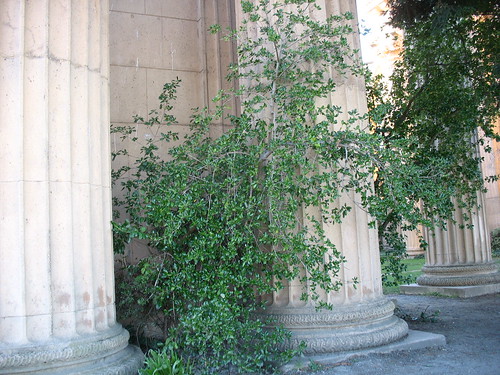
Maytenus boaria, the lovely Maytens tree.
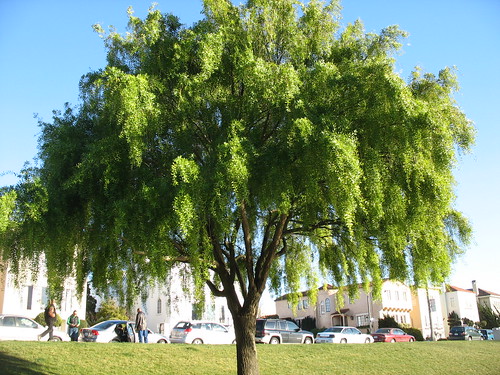
IMG_6783

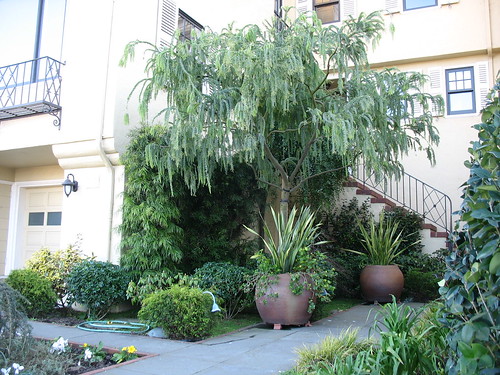
Around the park, beautiful homes with some nice front gardens, all professionally done I'm sure.
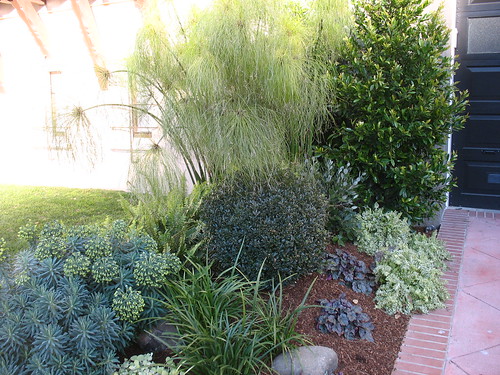
IMG_6788

IMG_6789

IMG_6794

IMG_6799

1/10/2007

Ask for an ocean view...

Nina takes it to the next level. Check it out!

Don't miss the travel archives, particularly Sicily '06 and Canadian Rockies '06.

It's the time of year...

...for seeds! I just added four of my favorite seed-sellers to the links list. They all have interesting websites and/or catalogs you might find useful and/or enjoyable.

(They're all in California, except for Territorial which is in Oregon.)

J.L. Hudson, Seedsman: I keep this groovy old-school catalog in the drawer of my nightstand. He also sells gibberellic acid kits.

Peaceful Valley Farm & Garden Supply: I did my soil test with these folks.

Swallowtail Garden Seeds: Great website with lots of pictures; they sell some hard-to-find seeds too.

Territorial Seed Company: I ordered most of my vegetable seeds from them.

Two links I've had up for awhile:

Seedhunt: This woman works at Suncrest Nursery (wholesalers) in Watsonville and runs her own seed business. She sells rare CA natives and exciting restios, among other things.

Theodore Payne Foundation: Dedicated to preserving and disseminating CA natives and wildflowers.


Please feel free to list some of your favorite seed sources in the comments.

1/08/2007

Can you identify birds?

I'm really impressed with Firefly's birding abilities. I bought a book to help me recognize avian visitors to my backyard, but it hasn't panned out. I see birds that aren't in the book, and the birds that are in the book don't seem to come around here. Except for the blue jays, and possibly some finches.

So I was happy to see Anne Raver's column in the New York Times. She's really good at birds too. She references the Cornell Lab of Ornithology website, and I want to say, "Why not just call it 'Cornell Ornithology Lab'?"

Well, they didn't ask me. Anyhoo, I've spent quite a lot of time at this dandy site, and it's much better than the book I bought. I want to alert you to it too in case you don't read the NYT. Because let's face it. Their Home and Garden section rarely has anything to do with actual gardening and that really bugs me.

1/07/2007

January's prelude to spring.

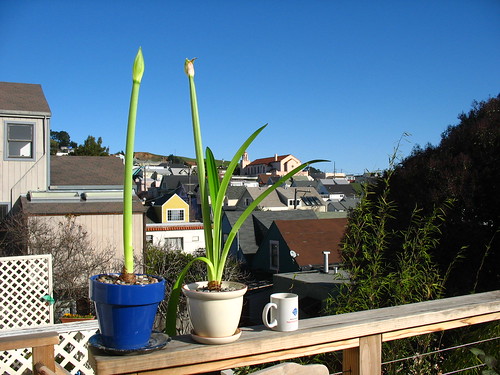
I planted the amaryllis in the white pot first and it took forever to come up. Then I planted in the one in the blue pot and it came up right away. I meant to stagger them, but now I have two at the same time. There are worse calamities. (They don't live outdoors...I just thought they'd like some direct light for a couple hours.)

IMG_6652

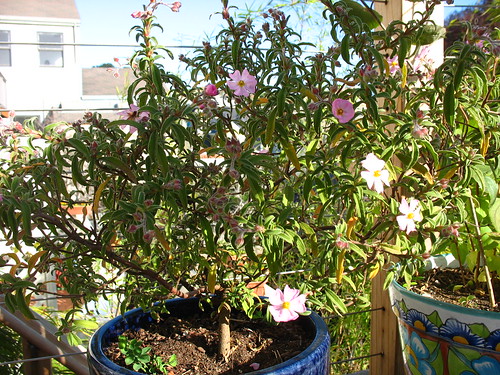
Cistus skanbergii usually has one or two flowers on it all year, but all the sudden I have a dozen this morning. By early spring it'll be covered with little flowers. Should that be Cistus x skanbergii? I'm too lazy to reach under the bed for Sunset.

IMG_6654

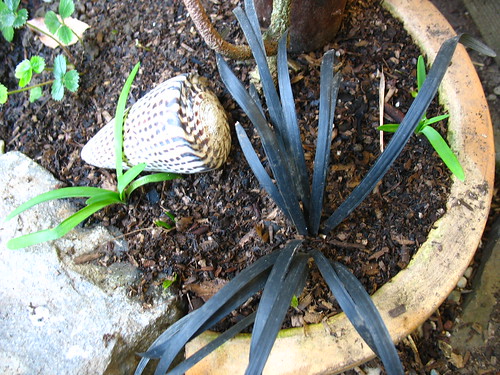
Next year I'll make a small pot of the strappy black ophiopogon and bright green ipheion. Don't you think that's a nice, easy combination? Bright green and black? And the ipheion makes that little blue star-flower.

IMG_6671

The little seedling back there is Heracleum lanatum (Cow parsnip)--a native I picked for habitat interest (that is, to attract bees and butterflies). I tucked a few seeds here and there and then sowed some in pots for good measure. Now I have five of them coming along. Which is fine, but they're biggish plants. I'm not sure how that's going to work out.

IMG_6666

Small narcissus of some sort. I've already forgotten what to expect from these.

IMG_6655

Two kissers kissing. Very spring-y.

IMG_6681

Noticing how old you look. Very winter-y. I'm getting puffy! And where's my chin going? Come back, chin!

It's hard to take a picture of yourself kissing.

The official history of the Garden Club of Palo Alto...

...[A]ll 85-some years of it, is full of library book donations, checks sent to the Save the Redwoods League, and all sorts of landscaping projects around town.

But between the lines of its staid minutes is some of the stuff of soap opera -- there's no real explanation, for example, of what led to the fuss of April 1924, when all the club's male members resigned en masse. Men were thereafter allowed as honorary members only.

Sometimes, the ire was a bit more public...

Link.

Wouldn't it be wonderful to follow the ins and outs of local garden club in the paper? I would love that.

I'll take you to the Gamble Garden in Palo Alto next week. I'm going to be down that way for a pruning class.

1/05/2007

More about bacteria.

This time in the air over Texas:
"[D]aily air samples were taken at several locations in San Antonio and Austin over a 17-week period. The samples were sent to Berkeley Lab where they were analyzed by the microarray. It found 1,800 types of bacteria, including some pathogens, wafting in the air over the two cities. This diverse population matches the complexity of soil populations, which is considered to be one of the richest habitats for microbes."

Link.

You hear that, Texas readers? Your air is teeming with bacteria! What do you have to say about that?

Note that this research is being funded in the name of homeland security. Everything's gotta have a reason I guess, but science for its own sake is fascinating enough, imo.

I composted my Christmas tree.

This guy gets to eat his.

070104-christmas

Is it me, or is there something slightly disturbing about this picture? It bothers me a little bit. He looks happy enough, but there's something unnatural looking about a baby elephant eating a tree. I feel worried for him.
Unlike the pie, pudding, and honeyed ham that may be haunting your fridge, though, pine trees' unique oils may actually help some animals' digestion, Kuehne said.

People too might benefit from a little bark—but not necessarily in their bites. Some doctors are touting supplements with a pine bark extract called Pycnogenol. Supporters claim the antioxidant compound can reduce asthma attacks, thin blood, improve circulation, lower blood pressure, and relieve symptoms of diabetes.

Link.

Pycnogenol? I've never heard of it. But then I don't know much about natural products. Pycnogenol.com has this to say:
More than 170 scientific articles and clinical trials have confirmed Pycnogenol’s safety, absence of toxicity and clinical efficacy over the past 35 years. Today, Pycnogenol® is one of the most researched ingredients in the natural product marketplace. Published findings have demonstrated Pycnogenol’s beneficial effects in cardiovascular health, skincare, cognitive function, diabetes health, inflammation, sports nutrition, asthma and allergy relief and menstrual disorders, among others.

And there's this 1998 report from UC Berkeley:
Pycnogenol is a combination of some 40 chemicals extracted from the bark of the French maritime pine, Pinus pinaster, which grows in many areas along the Atlantic coast of France and into North Africa. Extracts and teas of pine were commonly used by early Europeans and native Americans, and reportedly are used in Asian medicine as well.

While many scientists eschew research on chemical mixtures like Pycnogenol, Packer has long seen the value of looking at natural plant extracts, most of which are a mélange of chemicals.

It's true: most scientists do eschew research on chemical mixtures. Chemist that I am, I would have to number myself among the eschewers. I was trained to study one variable at a time. Plus, that's how the FDA likes it. Although Pycnogenol® is in some small clinical trials, lotsa luck getting the FDA to embrace those trial results.

I think some companies bankroll clinical trials just to get the credibility of being in clinical trials. They have no intention of launching a drug. They don't need to; they'll sell plenty of extract without the hassle of seeking FDA approval. Saying your stuff's been through clinical trials will be enough for some consumers. But people shouldn't think something is safe and effective just because it's been through clinical trials or scientists at notable institutions support it. (Thalidomide? Vioxx?) Be wary about what you put in your body.

1/03/2007

Science Corner

Read in Nature, vol. 444, issue no. 7122, page 982:
Climate change is allowing subordinate male [seals] on a remote Scottish island a chance to mate. Higher temperatures and lower rainfall mean that female grey seals forage over a wider range, making it more difficult for the top male to keep an eye on them all.

(Ambiguous references provided, so no source. Take it or leave it.)

ADDED: One of my favorite subjects of late is on the cover, the role of gut microbes in obesity.
"Although there is no doubt that human genetics plays a large part in determining body weight, it is equally undisputed that the increase in prevalence of obesity over the last 25 years cannot be attributed to changes in the human genome. The inference is that other factors are responsible, such as the availability of calorically dense foods, or the reduction in human activity in our daily lives. [Other work] raises the possibility that our gut bacteria are another factor that contributes to differences in body weight among individuals."

Two reports in this issue describe studies that suggest obesity alters the composition of intestinal microbiota. Of the trillions of bacteria that live in healthy human intestine, two groups dominate: the Firmicutes and the Bacteroidetes. It turns out the guts of obese people have a higher ratio of Firmicutes to Bacteroidetes than do the guts of lean people.

When two groups of obese people--one group eating a carbohydrate-restricted diet, and the other a fat-restricted diet--lost weight over the course of a year, both experienced a decrease in the ratio of Firmicutes to Bacteroidetes. That is, the composition of their intestinal microbiota became more like that of lean people. That's interesting, because how do the bacteria know whether they're living inside obese people or lean people?

It gets more interesting when those results are considered along with results from two studies in mice.

First, the scientists found the Fermicutes/Bacteroidetes situation in mice to be similar to that in humans.

Then they did a controlled experiment where they transferred obese mouse microbiota into the guts of lean, microbe-free mice.
Over a two-week period, mice [receiving] microbiota from obese mice extracted more calories from their food and had a modest fat gain that was statistically greater than that of mice receiving microbiota from lean mice. [T]hese data suggest that differences in the efficiency of caloric extraction from food may be determined by the composition of the microbiota, which, in turn, may contribute to differential body weights.

How did the researchers determine that mice receiving 'obese microbiota' extracted more calories from their food than the control group (who received 'lean microbiota')? They measured and compared calories left over in feces.

Interesting that 'obese microbiota' extract calories more efficiently than 'lean microbiota'. Lean hosts are the ones who need to extract calories most efficiently; obese hosts have stored calories to burn.

The authors note that questions about how and why gut microbiota is regulated should be answered before manipulating the microbiota to effect changes in obesity.


You know, it took the medical community almost twenty years to fully accept the idea that bacteria can cause gastric ulcers. Now everyone's heard of Helicobacter pylori. But that idea was a hard sell for a long time. Today we hear about viruses causing cancer and all kinds of things previous generations didn't connect. There's a long way to go before concluding bacteria cause obesity, but it shouldn't be deemed too far-fetched to consider.

Why does this interest a whoreticulturist?

When plants depend on soil microbes to fix life-sustaining nitrogen in nitrogen-poor soils and absorb minerals that are otherwise unavailable, and when those microbes depend in turn on the plant for food and whatever else, where does the plant end and the microbe begin? Separate the two and both fail. So it is with human life, going all the way back to the very beginning.

P.S. Mark my words: I predict we'll be hearing a lot about Fermicutes in the near future, just like we hear about good and bad cholesterol and trans fats.

1/01/2007

Snipped from the San Francisco Rose Society 2007 events calendar:
"BIG ROSE DADDY PRUNES"
by James Armstrong
For our first membership meeting of 2007, James Armstrong, SFRS Member, Consulting Rosarian and Prize Winning Rose Exhibitor will arrive with his gear in tow and proceed to demonstrate how to sharpen your tools and prune your Roses "Big Rose Daddy Style".
Jim will show more than one technique, regale us with antidotes and generally keep us in a happy mood.
James has also written CR Reports for our newsletter, with excellent advice, for the last three years! If you have not yet met him, now is your chance.

What more do you people want? I am so there. I'm gonna get down with the Big Rose Daddy style, be regaled with antidotes, and be kept, generally, in a happy mood. Do you think they'll let me blog Big Daddy? Do you want me to blog Big Daddy? You know you do.

Buena Vista Park

in the Haight-Ashbury. If these trees could talk, the stories they would tell. I lived in this neighborhood for a year in the early 1990s (1990, in fact--I was 20 and 21 years old then), but I don't recall ever visiting.

37 acres (and, hey, 37 years), and all I know about the place is what I've heard from other people and read in books. How different I am now!

IMG_6643

For one thing, I can identify most of the plants growing here! Quite a few are Bay Area natives, including these three:

Garrya elliptica (Garryaceae), the coast silktassel bush. Those long, white catkins start growing in Nov-Dec, and put on quite a show in Jan and Feb. The whole tree becomes festooned with white tassels. Then it looks pretty ratty when the catkins die, so time to prune. This one needs at least another two weeks before it's ready for prime time.

IMG_6638

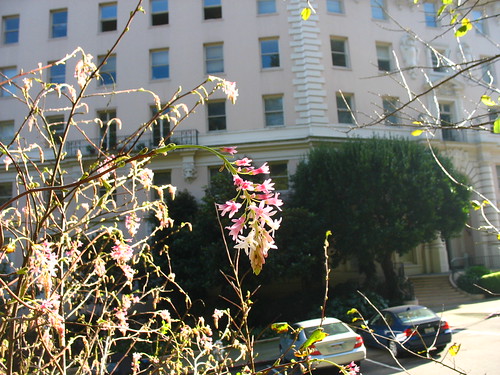
Another good one for winter interest: Ribes sanguineum var. glutinosum. Currant, in the Grossulariaceae. Semi-deciduous shrub. I have three Ribes in my garden. This one could use some thinning. Clusters of pink flowers hang from mostly leafless stems. By Feb-Mar, the whole thing is covered in bloom. Hummers sip the nectar, and then finches eat the berries. (The building in the background used to be a hospital, but now it's condominiums. It's on the National Register of Historic Places for some reason.)

IMG_6607

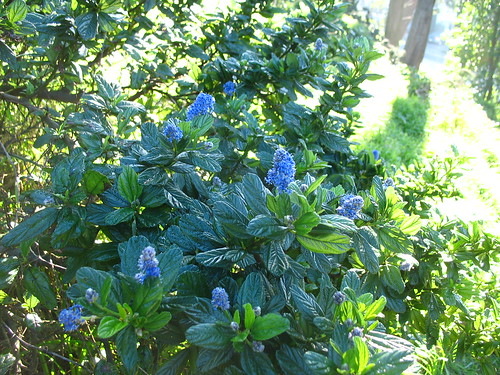
Ceanothus (Rhamnaceae). I can only ID a few species of Ceanothus and I'm not going to take a shot at this one. They all look alike to me except for a few that have very distinct leaves or growth habits.

IMG_6627

Mostly mansions ring the park, and I've always wondered about that because I think of it as a seedy park. Probably San Francisco's seediest. (And by seedy, I mean, you know, rundown, disreputable...not full of garden seeds. Although, I'm sure there are a lot of seeds here too.)

IMG_6623

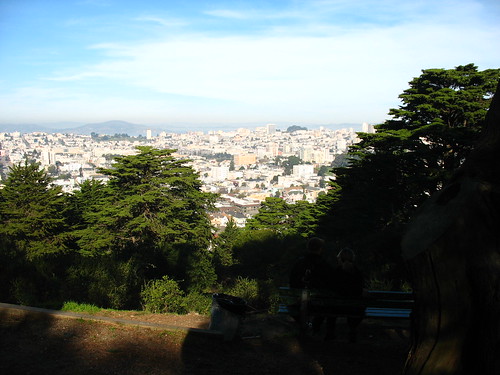
We're on a hilltop--so nice views.

IMG_6611

This is also San Francisco's oldest park (established in 1867), and some of the trees are believed to be original, but I wouldn't know which ones.

IMG_6644

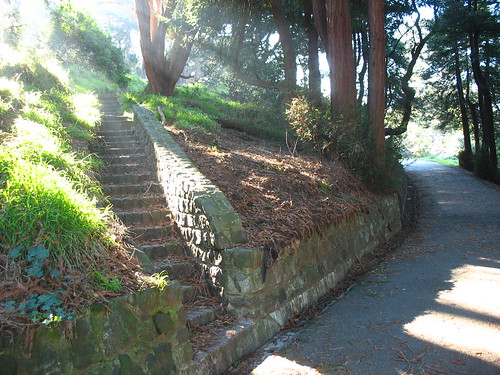
Believe it or not, WPA workers built these drainages with marble from tombstones when San Francisco's cemeteries were moved to Colma!

IMG_6641

File that under things that would never happen today.

12/31/2006

A short walk in the small city garden

Always a work in progress, but I finished the cobblestone path a few days ago. I'm holding the camera at waist-level.


Come back in the spring and summer, and maybe we'll do this again.

I'm surprised how long it takes YouTube to "process" a video after it's been uploaded. This one didn't become available until three hours after I finished the upload! Apparently patience is a virtue...and not just in gardening.
San Francisco, once a blue-collar town, has changed in recent years as the port and manufacturing faded away. Now it's a city of service industries, with old neighborhoods next to new high-rises.

"A big city for people who don't like big cities," says Neil Olson, a management consultant for lawyers, who moved to San Francisco 20 years ago.

Like any city, San Francisco has its downside -- it is losing its middle class and its children. The number of kids in schools has declined from 93,000 in 1968 to 54,500 now, according to Supervisor Ed Jew, who was elected from the Sunset District last fall on a platform of trying to hold on to families and small businesses.

The city's streets are full of beggars, and some of the homeless sleep in the doorways of swanky shops at night. Sometimes 21st- century San Francisco looks like Charles Dickens' 19th-century London.

The golden times of the past also had their dark sides. In the Bonanza days of the 1870s, the largest hotel in the country was built in San Francisco, the rich drank champagne and built gingerbread palaces on Nob Hill, the city was stained with anti-Chinese riots, and the Barbary Coast was a dark and dangerous place of drugs, prostitution and crime.

"The place was full of contradictions," Charles Caldwell Dobie wrote in "San Francisco, A Pageant."

San Francisco of the here and now has contradictions, too, many of them shaped by economic forces.

Link.

12/30/2006

"In order to avoid offending religious fundamentalists, our National Park Service is under orders to suspend its belief in geology," stated PEER Executive Director Jeff Ruch. "It is disconcerting that the official position of a national park as to the geologic age of the Grand Canyon is 'no comment.'"

Link and link.
"A barge carrying one of the original Napa Valley homes floats down the Napa River to the building's destination in Benicia. House mover Phil Joy saved the historic building from destruction by engineering the transport of the house, built in 1895 on land that is now planned for a golf course. Chronicle photo by Michael Macor."

ba_house24_022_mac

Link.

12/29/2006

Dare to dream.

That's what I'm gonna do in my 2007 vegetable garden--by giving melons a shot.

Growing melons in cool, coastal California: Inadvisable. It's not hot enough. Requires micromanagement.

In her book, SF vegetable gardening guru Pam Peirce has this to say:
Every few years I come across a listing for a 'very early' [melon] that is supposed to bear fruit even in cool weather. So far, my success has been limited to the two-and-a-half-inch cantaloupe [described elsewhere]. And cantaloupe is probably the melon most likely to succeed here!


Well, I'm going with Territorial Seed's Earlidew ("An early hybrid honeydew that is as well suited to cool summer growing conditions as any melon we've evaluated." 80 days), and Cook's Garden's Charentais ("The original French melon known for its...ability to ripen even in cool areas." 75 days).

Maybe I'll get a boost from global warming.

Look how beautiful Charentais is. Right out of some old still-life by Cezanne or something.

charentais

I knew someone in grad school who thought melon flesh smelled like rotten meat. Or something like that. I'll bet he would hate that picture.
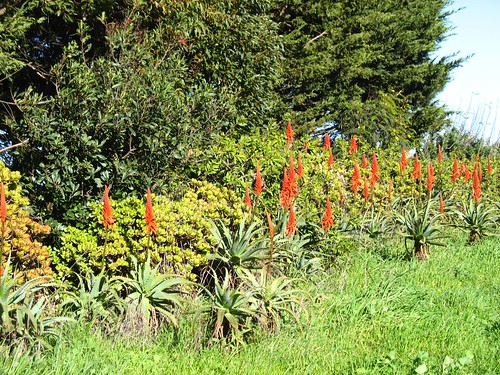
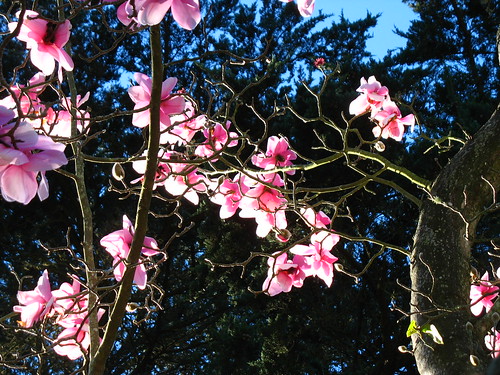
Magnolia campbellii

I believe. Possibly a pink-flowering M. denudata. I took this picture the day after a battering windstorm. You don't see the distinguishing 'cup-and-saucer' flower pattern at all in this picture.

IMG_6546

On M. campbellii, famed Bay Area botanist Elizabeth McClintock wrote, "[The flower's] innermost tepals form an erect, conelike covering that encloses the central column of stamens and pistils; the remaining tepals spread horizontally. It is this characteristic 'cup-and-saucer' flower shape that distinguishes Campbell's magnolia from other deciduous Asiatic magnolias." (Weird--Amazon scanned the back cover of McClintock's book.)

So how do the flowers get pollinated if fleshy tepals enclose the sex parts? "Magnolias are among the oldest of flowering plants, having evolved more than sixty-five million years ago when earth was dominated by ferns and conifers... Beetles, ancient forms of insect life, are thought to be the original pollinators of magnolias, feeding on both the plentiful pollen and the sweet tissue of the [tepals]." Ibid.

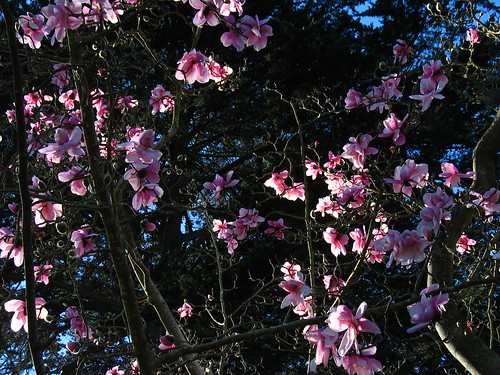
Another shot of the same tree, looking more cup-and-saucery.

IMG_6549

12/27/2006

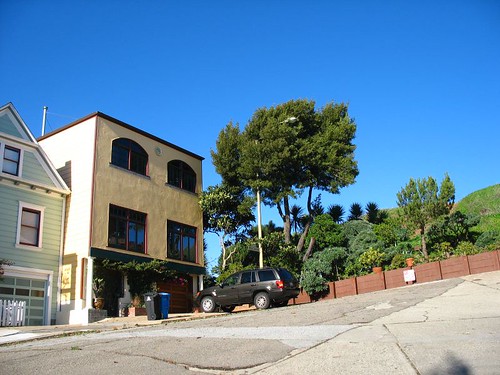
Bernal Heights, San Francisco. December 27, 2006.

San Francisco's best neighborhood, if I do say so myself.

IMG_6481

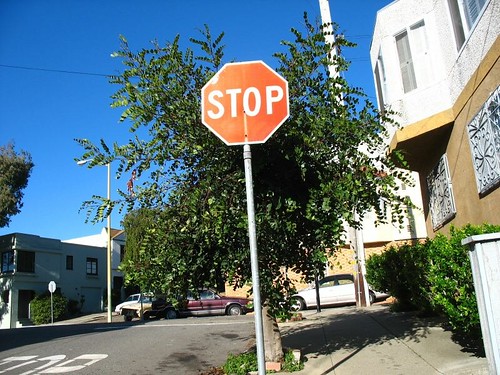
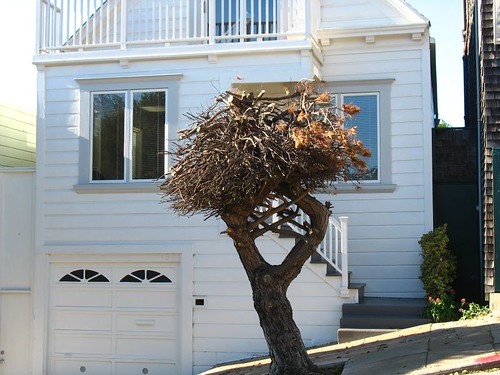
"Stop, and prune me."

IMG_6454

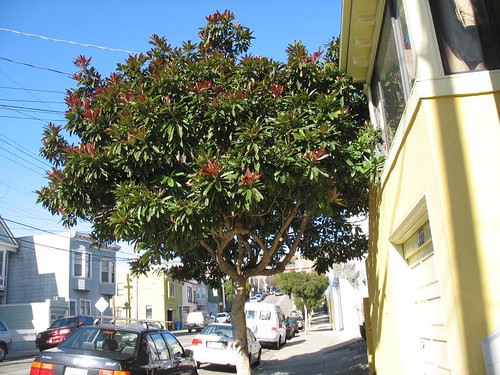
"And me too!" It must be hard to enjoy your Eriobotrya deflexa when it's about to smash through your living room window. I can't quite imagine what must go on in people's minds to let these trees go on like this.

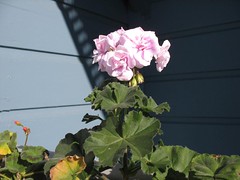
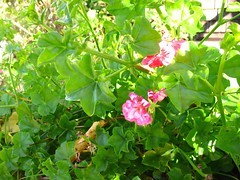
Over the years, I've had a lot of nasty things to say about geraniums (yes, Pelargonium). I take it all back, starting several months ago. I like them now.

IMG_6452 IMG_6463

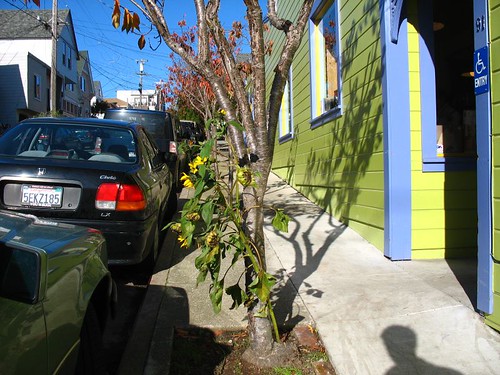
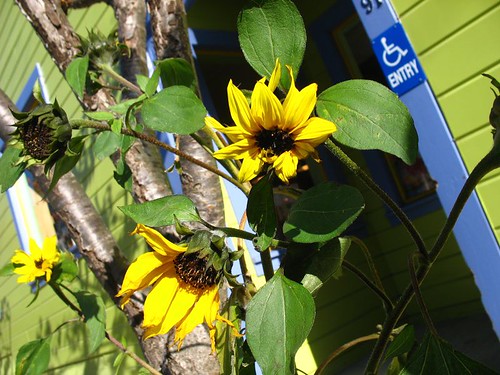
This sunflower (?) is cute.

IMG_6458

IMG_6459

Does your video store quote Thoreau? Mine does. Nyah, nyah!

IMG_6455

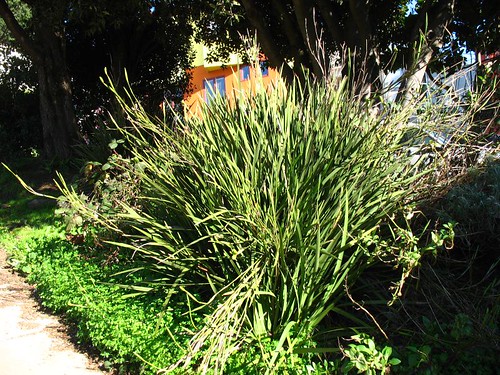
People, please do not plant Dietes unless you intend to divide it once in awhile. Please!

IMG_6488

If I owned this particular million dollar house, I would get that dead tree gone so fast. It's been there for a long time.

IMG_6491

These people have a nice, rugged Mediterranean garden...on public land I believe. (And when I say Mediterranean, I mean Mediterranean climate. Please don't tell me these aren't necessarily Mediterranean plants. I got that.)

IMG_6489

IMG_6499

Aloes blooming everywhere.

IMG_6525

A particularly floriferous Fremontodendron.

IMG_6533

It's in bloom whenever I walk by, all year long.

Cute little puppy, barking at me furiously. Aww!

IMG_6501

12/24/2006

The first 80 seconds or so really captures a lot of my general mood this year.


The rest of it's funny too.

Not safe for work, but I don't give a fuck. :)

12/23/2006

Dear diary,

Today I went to the stone yard to pick up the last 10 or so cobbles I need to finish my garden path, but they were closed. Closed--the day before Christmas Eve! Can you imagine that, diary? I was so sad, all I could do was go home and clean up.

Then I remembered I had a rose bush to plant because I went by my nursery yesterday to buy two big pots for containerizing Asclepias speciosa, and I was quite surprised to see they'd already received their full shipment of roses. Roses! Caught totally off-guard, I bought a bareroot Climbing Joseph's Coat since I'd at least had that one in the back of my mind for awhile.

I told a friend I wanted to try grafting red, orange and yellow roses onto one rootstock so I could have a three-in-one rose going on in my small garden (like Fruit Loops), and she said, "Just buy Climbing Joseph's Coat." So that's what I did. Because let's face it diary, I don't know how to graft roses, and I have enough on my plate already. Grafting roses can wait until next year.

So I fixed up soil in a big pot for Climbing Joseph's Coat. I'm not going to let it climb tho'; I'll be pruning it into a bush because I know that rose can take it.

And I decided what to do with all that extra dirt I've been generating lately. I'm going to build another big raised bed for a spring/summer vegetable garden. I've been meaning to try potatoes; here's my chance. Next week, my nursery's scheduled to get fruit trees. Maybe I should get a fruit tree too? It would be nice to espalier a fruit tree where the Dahlia imperialis will soon be no more.

Okay, diary, I'll write more later. It's been a long morning and I want to take a nap before dinner.

12/22/2006

Another one. Bigger than the other day. At least a 4.0.

They're calling it a 3.7. Well, it felt stronger than that to me.